A practical look at cluster protection in Certified Kubernetes Security Specialist
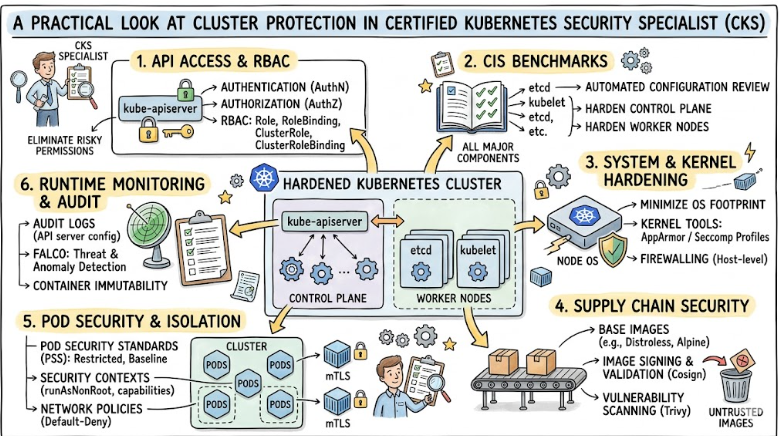 Introduction
In the current era of cloud-native technology, the security of containerized environments is regarded as a top priority for every organization. As Kubernetes becomes the standard for orchestration, the need for professionals who can secure these clusters is seen to be growing rapidly. This guide is prepared to help engineers understand the path toward becoming a recognized expert in Kubernetes security.
What is Certified Kubernetes Security Specialist (CKS)
The Certified Kubernetes Security Specialist (CKS) is a performance-based certification exam that validates the ability of a professional to secure container-based applications and Kubernetes platforms during build, deployment, and runtime. It is considered an advanced-level certification offered by the Cloud Native Computing Foundation (CNCF) in collaboration with The Linux Foundation.Unlike traditional exams, this certification is conducted in a hands-on environment. Candidates are required to solve real-world security challenges within a command-line interface. Mastery over various security tools and Kubernetes configurations is expected from those who attempt this exam.
Why it matters today?
Security is no longer treated as an afterthought in the software development lifecycle. With the rise of cyber threats, every layer of the tech stack is expected to be protected. Kubernetes, being a complex system, has many moving parts that can be vulnerable if not configured correctly.Organizations are now moving toward a "Shift Left" security approach where security is integrated from the start. A professional with CKS credentials is seen as a vital asset because they can prevent breaches before they happen. The trust of stakeholders is maintained when a system is proved to be resilient against attacks.
Why Certified Kubernetes Security Specialist (CKS) certifications are important
The importance of this certification is rooted in the high demand for specialized security skills. General knowledge of Kubernetes is no longer sufficient for senior roles. A CKS certification acts as a formal validation that an engineer can handle sensitive data and secure critical infrastructure.It is also observed that professionals holding this certification often receive better career opportunities and higher compensation. Since the exam is difficult and requires a prerequisite (CKA), it filters out casual learners and highlights those with deep technical commitment. It is considered a benchmark for excellence in the DevOps and DevSecOps community.
Why Choose DevOpsSchool?
DevOpsSchool is recognized as a leading institution for technical training. The curriculum is designed by industry experts who have spent decades in the field. Students are provided with hands-on labs that mimic real-world production environments, ensuring that learning is not just theoretical.Mentorship is a key feature at DevOpsSchool, where every learner is guided through complex topics with patience. The support provided for exam preparation and post-training queries is highly rated by global professionals. Choosing this platform ensures that a solid foundation is built for a successful career in Kubernetes security.
Certification Deep-Dive: Certified Kubernetes Security Specialist (CKS)
What is this certification?
This certification is a performance-based test focused on the security of Kubernetes clusters. It covers the entire lifecycle of a container, including build, deployment, and runtime security.
Who should take this certification?
This path is intended for those who already hold a valid CKA (Certified Kubernetes Administrator) credential. It is best suited for security engineers, DevOps professionals, and cloud architects who are responsible for protecting cloud-native environments.
Certification Overview Table
| Track | Level | Who it’s for | Prerequisites | Skills Covered | Recommended Order |
| DevSecOps | Expert | Security Engineers | CKA Certification | Cluster Hardening, Runtime Security | After CKA |
| DevOps | Advanced | Platform Engineers | CKA Certification | Network Policies, Secret Management | After CKA |
| SRE | Expert | Site Reliability Engineers | CKA Certification | Monitoring, Auditing, Logging | After CKA |
| AIOps | Advanced | Data Architects | Cloud Knowledge | Container Security, Image Scanning | After Cloud Basics |
| DataOps | Advanced | Data Engineers | Basic K8s | Securing Data at Rest and Motion | After CKA |
| FinOps | Professional | Cloud Financial Ops | Basic Cloud | Resource Quotas, Security Costs | After Cloud Basics |
Skills you will gain
- The ability to harden a Kubernetes cluster against external and internal threats is developed.
- Proficiency in setting up network policies to restrict unauthorized communication is gained.
- Expertise in using tools like Falco for runtime security monitoring is achieved.
- Knowledge of image scanning and vulnerability management is deeply understood.
- Skills in configuring Role-Based Access Control (RBAC) with high precision are refined.
- The management of secrets and sensitive information within the cluster is mastered.
- Competency in auditing and logging for forensic analysis is built.
Real-world projects you should be able to do after this certification
- A complete security audit of a production-grade Kubernetes cluster can be performed.
- A secure CI/CD pipeline with automated image scanning can be implemented.
- Network segmentation for different microservices can be designed and deployed.
- Runtime threat detection systems can be set up to alert on suspicious activities.
- A "Least Privilege" access model for all developers and service accounts can be created.
- Kernel-level hardening using AppArmor or Seccomp profiles can be applied to containers.
Preparation Plan
7–14 days plan
During this short period, the focus is placed entirely on the exam syllabus. High-level concepts like Cluster Hardening and System Hardening are reviewed. Practice labs are used to become comfortable with the command line and the specific security tools mentioned in the curriculum.
30 days plan
A balanced approach is taken where two hours are dedicated every day to hands-on practice. The first two weeks are spent understanding the core security concepts. The remaining two weeks are used to solve mock exams and troubleshoot common security misconfigurations in a test environment.
60 days plan
This is the most recommended path for deep learning. The first month is used to study each domain of the CKS in detail. Real-world scenarios are built and secured manually. The second month is focused on speed and accuracy, ensuring that the performance-based tasks can be completed within the time limit of the exam.
Common mistakes to avoid
- Attempting the CKS without a solid understanding of the CKA concepts is a frequent error.
- Time management is often ignored, leading to unfinished tasks during the exam.
- The official documentation is not used effectively; being familiar with where to find security snippets is crucial.
- Typos in YAML files are a common cause of failure; careful indentation is required.
- Ignoring the small details in the "Cluster Hardening" section can lead to significant point loss.
Best next certification after this
Same track
The Certified Kubernetes Administrator (CKA) should be maintained, and specialized security certifications from cloud providers like Azure or AWS are suggested to be taken next.
Cross-track
The Certified Kubernetes Application Developer (CKAD) is a good choice to understand the developer's perspective on security.
Leadership / management
For those moving into management, the CISM (Certified Information Security Manager) or a leadership course in DevOps transformation is recommended.
Choose Your Learning Path
DevOps
This path is chosen by those who want to automate infrastructure while keeping it secure. It focuses on the integration of security tools within the automation process.
DevSecOps
This is the primary path for CKS candidates. It emphasizes "Security as Code" and ensures that security is a shared responsibility across the entire team.
Site Reliability Engineering (SRE)
In this path, security is viewed as a component of reliability. It is focused on maintaining uptime even during a security incident.
AIOps / MLOps
Security for machine learning models and data pipelines is the focus here. CKS helps in securing the underlying infrastructure where these models run.
DataOps
This path is best for those handling large datasets. It ensures that the data processing clusters are protected from unauthorized access.
FinOps
While FinOps is about cost, this path ensures that security measures do not lead to unexpected cloud bills while keeping the cluster safe.
Role → Recommended Certifications Mapping
| Role | Primary Certification | Secondary Certification |
| DevOps Engineer | CKA | CKS |
| Site Reliability Engineer (SRE) | CKA | CKS |
| Platform Engineer | CKS | KCNA |
| Cloud Engineer | CKA | CKS |
| Security Engineer | CKS | CISA |
| Data Engineer | CKA | CKAD |
| FinOps Practitioner | Cloud Practitioner | CKS |
| Engineering Manager | CKA | CISM |
Next Certifications to Take
The Certified Kubernetes Administrator (CKA) is considered the most logical step if it has not been perfected yet. This foundation is necessary for all advanced Kubernetes tasks.The Certified DevSecOps Professional (CDP) is recommended as a cross-track option. It broadens the security knowledge beyond just Kubernetes and covers the entire pipeline.A Master’s in Engineering Management or a specialized leadership certification is suggested for those aiming for executive roles. These programs help in bridging the gap between technical skill and business strategy.
Training & Certification Support Institutions
DevOpsSchool
Complete training for CKS is provided here with a focus on real-world application. The labs are designed to be challenging and informative for working professionals.
CotocusSpecialized consulting and training are offered to help organizations adopt Kubernetes security. Their approach is very practical and results-oriented.
ScmGalaxyA vast library of resources and community support is available for learners. It is a great place to find tutorials and guides on various DevOps tools.
BestDevOpsQuality training programs are conducted for those looking to advance their careers in cloud-native technologies. Their curriculum is always kept up to date.
devsecopsschool.comThis institution focuses purely on the security aspects of DevOps. It is an ideal place for someone wanting to specialize as a Security Engineer.
sreschool.comReliability and security are taught as integrated subjects. This school is perfect for SREs who want to deepen their infrastructure knowledge.
aiopsschool.comThe intersection of Artificial Intelligence and Operations is explored here. Security for AI infrastructure is a key part of their training.
dataopsschool.comData professionals are trained to handle large scale infrastructure securely. Their courses are tailored for data scientists and engineers.
finopsschool.comThe financial management of cloud resources is the main focus. They provide insights into how security and cost management go hand in hand.
FAQs Section
- What is the difficulty level of the CKS exam?
The difficulty level is considered high because it is a performance-based exam that requires a deep understanding of security. - How much time is required to prepare for CKS?
It is estimated that four to eight weeks are needed depending on the prior experience of the candidate. - What are the prerequisites for the CKS certification?
A valid Certified Kubernetes Administrator (CKA) certification is mandatory before taking the CKS exam. - Is there a specific sequence for Kubernetes certifications?
Yes, it is generally recommended to complete KCNA, then CKA, and finally CKS for a structured learning path. - What is the career value of holding a CKS credential?
High career value is associated with this certification, as it marks the professional as a security expert in a niche market. - Which job roles benefit most from CKS?
DevOps Engineers, Security Engineers, and Cloud Architects are the primary roles that benefit from this certification. - How long is the CKS certification valid?
The certification remains valid for a period of two years from the date it is earned. - Can the exam be retaken if failed?
One free retake is usually provided by the Linux Foundation if the first attempt is not successful. - Are there any hardware requirements for the exam?
A stable internet connection and a computer with a functional webcam and microphone are required for the proctored exam. - Is the exam multiple-choice?
No, the exam is entirely hands-on and requires solving tasks in a real Kubernetes environment. - Does CKS cover cloud-specific security?
The focus is on Kubernetes-native security, but the principles are applicable across all cloud providers. - What is the passing score for the CKS?
A score of 67% or higher is typically required to pass the exam.
Certified Kubernetes Security Specialist (CKS) Specific FAQs
- What is the main focus of CKS?
The main focus is placed on the security of the cluster, including build, deployment, and runtime phases. - Is Falco included in the syllabus?
Yes, the use of Falco for runtime security monitoring is a significant part of the exam. - Are network policies tested?
The configuration of ingress and egress network policies is a core requirement for the exam. - Is image scanning required?
Candidates are expected to know how to scan container images for vulnerabilities using tools like Trivy. - How is RBAC tested in CKS?
The ability to create restricted roles and role bindings to minimize permissions is evaluated. - What is "Cluster Hardening"?
It involves securing the API server, etcd, and other components from unauthorized access. - Are kernel security modules like AppArmor covered?
Yes, the implementation of AppArmor and Seccomp profiles is part of the system hardening domain. - Can I use the Kubernetes documentation during the exam?
Access to the official Kubernetes documentation and specific security tool docs is allowed during the test.
Testimonials
AditiThe depth of knowledge gained through this training was exceptional. The security concepts are now much clearer and can be applied to my daily tasks with ease.
RohanConfidence in handling production clusters has grown significantly. The hands-on labs provided a realistic experience that was very helpful for the exam.
VikramA new perspective on DevSecOps was developed during this course. The focus on runtime security was particularly valuable for my professional growth.
PriyaThe clarity provided on complex topics like RBAC and Network Policies was amazing. My career path is now much more defined and secure.
ArjunThe training helped in understanding how to bridge the gap between development and security. It was a practical and highly rewarding experience.
Conclusion
The Certified Kubernetes Security Specialist (CKS) certification is an essential milestone for any professional working in the cloud-native space. It provides the skills needed to protect complex environments and ensures that security is maintained at every level. By following a structured learning path and choosing the right training partners, a career can be transformed. The long-term benefits include not only better job prospects but also the satisfaction of building resilient and safe systems for the global market.
