Certified DevOps Architect Skills and Responsibilities Explained
Introduction
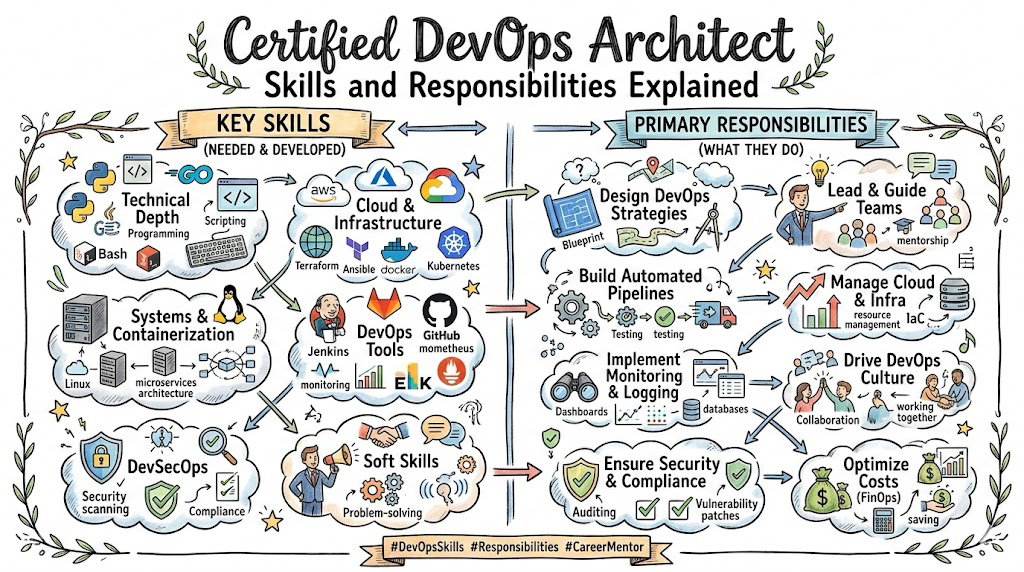
A Certified DevOps Architect is a professional who designs the big picture of how software is built and delivered. While a DevOps engineer might focus on specific tools, an architect looks at the entire lifecycle. This role involves picking the right strategies for automation, security, and scaling. It is a bridge between business goals and technical execution.
Why it matters in today’s software, cloud, and automation ecosystem
Software is being updated every single day. Companies cannot afford slow releases or system crashes. A cloud-based world needs someone who understands how different parts like containers, microservices, and monitoring work together. A DevOps Architect ensures that the automation is not just fast, but also smart and sustainable.
Why certifications are important for engineers and managers
Certifications act as a proof of knowledge. For an engineer, it shows that you have followed a structured learning path and mastered the industry standards. For a manager, having certified team members means the projects are in safe hands. It builds trust within the team and with clients. It also helps in keeping up with the fast-changing tech landscape without getting lost in the noise.
Certification Overview Table
| Track | Level | Who it’s for | Prerequisites | Skills Covered | Recommended Order | Official Link |
| DevOps Architecture | Expert | Lead Engineers, Managers | Basic DevOps Knowledge | CI/CD Design, Scaling, Security, Governance | After DevOps Master | Link |
Why Choose DevOpsSchool?
DevOpsSchool is chosen by many because the focus is on practical learning. The training is built by people who have worked in the field for a long time. The curriculum is updated regularly to match what companies are actually looking for. Instead of just theory, the emphasis is placed on solving real-world problems that occur in a production environment.
Certification Deep-Dive
Certified DevOps Architect
What is this certification?This is an expert-level program designed to teach how to architect a complete DevOps framework. It focuses on the "how" and "why" of automation strategies across various platforms.Who should take this certification?This is ideal for senior engineers, technical leads, and managers who want to move away from daily coding and into system design and leadership.Skills you will gain
- Designing end-to-end CI/CD pipelines
- Cloud infrastructure orchestration
- Implementing security at the design level
- Cost optimization and resource management
- Strategy for monitoring and logging
Real-world projects you should be able to do
- Building a zero-downtime deployment strategy for a global app
- Migrating a legacy system to a containerized microservices architecture
- Setting up a central governance model for multiple dev teams
Preparation plan
- 7–14 days plan: Focus on understanding the core pillars of DevOps architecture and reviewing case studies of successful automation.
- 30 days plan: Dive deep into specific tools for orchestration and security. Start mapping out architectural diagrams for complex workflows.
- 60 days plan: Perform hands-on labs on multiple cloud providers and practice designing high-availability systems.
Common mistakes to avoid
- Focusing only on tools instead of the underlying process.
- Ignoring the cultural aspect of DevOps within a team.
- Over-complicating the architecture with too many unnecessary tools.
Best next certification after this
- Same track: Specialized Cloud Architect certifications.
- Cross-track: DevSecOps Professional or SRE Master.
- Leadership / management: IT Strategy or Engineering Management programs.
Choose Your Learning Path
- DevOps: Best for those who want to master the flow of code from a developer's laptop to the live server.
- DevSecOps: Ideal for professionals who believe security should be built into the code, not added later.
- Site Reliability Engineering (SRE): Perfect for those who love keeping systems stable, scalable, and highly available.
- AIOps / MLOps: Designed for data-heavy environments where AI is used to manage operations or where machine learning models need automation.
- DataOps: Best for data engineers who want to bring agility and quality to data pipelines.
- FinOps: For those who want to manage and optimize the costs of cloud spending in large organizations.
Role → Recommended Certifications Mapping
- DevOps Engineer: Certified DevOps Professional, Certified DevOps Master.
- Site Reliability Engineer (SRE): SRE Foundation, Certified SRE Professional.
- Platform Engineer: Kubernetes Specialist, Infrastructure as Code Professional.
- Cloud Engineer: Cloud Operations Associate, Multi-Cloud Architect.
- Security Engineer: DevSecOps Professional, Cloud Security Expert.
- Data Engineer: DataOps Master, Big Data Automation Specialist.
- FinOps Practitioner: FinOps Certified Professional, Cloud Cost Optimizer.
- Engineering Manager: Certified DevOps Architect, Agile Leadership for Tech.
Next Certifications to Take
For any learner who has completed a foundational level, the following progression is suggested:
- Same-track: Move toward a "Master" or "Architect" level within your current domain to deepen your expertise.
- Cross-track: Explore a Security or SRE certification to become a more versatile "T-shaped" professional.
- Leadership-focused: Consider certifications in Project Management or Technical Leadership to prepare for senior management roles.
Training & Certification Support Institutions
DevOpsSchoolComplete support is provided for both training and certification. A wide range of courses is offered, covering every aspect of the DevOps ecosystem with a focus on hands-on labs.CotocusProfessional training services are delivered with a focus on specialized tech stacks. Support is given to individuals and teams to master cloud-native technologies effectively.ScmGalaxyA large community and knowledge base are maintained here. Resources and guidance are provided for those looking to excel in Configuration Management and CI/CD.BestDevOpsCurated learning paths are offered for beginners and experts alike. The focus is kept on simplified learning to ensure every student can grasp complex topics.devsecopsschool.comSpecialized training is conducted here for the security track. The integration of security into the DevOps pipeline is taught through practical examples.sreschool.comDeep-dive courses into reliability and system stability are provided. The principles of Google-style SRE are explained in a way that is easy to apply.aiopsschool.comEducation on the future of operations is delivered. The use of Artificial Intelligence to automate and improve IT operations is the primary focus.dataopsschool.comTraining is provided for the modern data era. How to manage data pipelines with the same agility as software code is taught here.finopsschool.comInstruction is given on the financial side of the cloud. Professionals are taught how to balance speed, cost, and quality in cloud environments.
FAQs Section
General Career FAQs
- Is the certification difficult?
It is designed to be challenging but achievable with consistent study and hands-on practice. - How much time is required to prepare?
Most professionals find that 2 to 3 months of steady learning is sufficient. - Are there any prerequisites?
Basic knowledge of Linux, scripting, and cloud concepts is usually recommended. - In what sequence should I take certifications?
Start with a Foundation or Professional level before moving to Master or Architect. - What is the career value?
Higher salaries and access to leadership roles are common outcomes for certified professionals. - Does it help in job growth?
Yes, it helps you stand out during interviews and performance reviews. - Is hands-on experience required? While not always mandatory for the exam, it is highly recommended for real-world success.
- Can a manager take these courses?
Yes, it helps managers understand the technical challenges their teams face. - How long is the certification valid?
Most certifications are valid for 2 to 3 years, after which a renewal or upgrade is suggested. - Is online training available?
Yes, flexible online options are provided by most partner institutions. - Do these certifications cover multiple clouds?
Yes, the principles taught are generally applicable to AWS, Azure, and Google Cloud. - Will this help me move from Dev to Ops?
Absolutely, it provides the bridge needed to understand the "other side" of software.
Certified DevOps Architect FAQs
- What makes the Architect level different?
It focuses on high-level design and strategy rather than just tool implementation. - Who is the ideal candidate for this?
Someone with at least 5 years of experience in the IT industry. - What is the main goal of this program?
To prepare you to lead large-scale DevOps transformations. - Does it cover cost management?
Yes, cost-effective architecture is a core part of the syllabus. - Is security included?
Yes, "Security by Design" is taught as a fundamental architectural principle. - Will I learn about microservices?
Yes, designing for microservices and containers is a key skill covered. - How is the exam conducted?
It usually involves a mix of theoretical questions and scenario-based problems. - Can I lead a team after this?
Yes, the certification provides the technical authority needed to lead engineering teams.
Testimonials
AmanThe gap between being an engineer and an architect was bridged. A lot of confidence was gained in designing complex pipelines.DeepikaReal-world scenarios were used throughout the training. The way systems are viewed has completely changed for the better.MarcusCareer clarity was finally achieved. The path to becoming a lead engineer became much clearer after this program.VikramThe focus on simple explanations for hard topics was appreciated. My skills were improved significantly in just a few months.SureshAs a manager, a better understanding of my team's workflow was developed. The project planning process is now much smoother.
Conclusion
The journey to becoming a Certified DevOps Architect is one of growth and strategic thinking. In an industry that never stops moving, this certification provides the stability and authority needed to lead. Long-term career benefits include not just better pay, but the ability to shape how modern technology is built. Strategic learning and careful planning of your certification path will ensure that you remain a valuable asset to any organization in the years to come.Certified DevOps Architect
