Designing an Incident Response Strategy Around SRE Principles
When a digital platform crashes in the middle of a busy workday, users lose patience within seconds. Behind every fast web app or online service is a deliberate system design that keeps servers healthy under heavy traffic. This technical discipline is called Site Reliability Engineering. Keeping complex cloud infrastructure online requires proper education, systematic planning, and smart tooling. Platforms like SRESchool.com help engineers and enterprises learn these essential production skills through specialized learning resources, courses, and advisory services.
What Is SRESchool.com?
SRESchool.com operates as a global learning hub and professional service platform centered entirely around Site Reliability Engineering. It helps technical professionals figure out how to design systems that stay online, handle scaling demands, and bounce back quickly when faults occur.Rather than waiting for servers to fail and fixing them manually, the platform promotes proactive production engineering. It provides structured pathways and expert guidance to help teams stop constant firefighting and start building stable, long-lasting software architectures.
What Is Site Reliability Engineering?
Site Reliability Engineering connects software development with IT operations. Historically, software teams wanted to launch new features as fast as possible, while operations teams wanted to leave servers untouched to prevent crashes.SRE solves this operational tug-of-war by applying software engineering methods to infrastructure challenges. Instead of restarting broken servers by hand, reliability engineers write automation scripts and code to monitor system health. They measure uptime, track performance, and protect the end-user experience.
Why System Reliability Matters
Modern software runs on complex webs of cloud infrastructure and third-party dependencies. If one minor component fails in the background, it can trigger a chain reaction that crashes an entire application.Downtime damages user trust and drains company revenue. Waiting for a major outage to happen is no longer a viable strategy. Teams need structured reliability practices to catch issues early, manage traffic surges safely, and keep data secure.
Mastering Production Skills Through SRESchool SRE Training
Effective SRE Training teaches engineering teams how to manage production environments without burning out staff. Good training programs focus on system design, performance metrics, and incident management.Learners discover how to set clear reliability goals, build smart monitoring dashboards, and eliminate repetitive chores using automation. The ultimate objective is to give engineers the confidence to handle real-world traffic spikes without panic.
Understanding SRE Certification
An SRE Certification allows professionals to validate their knowledge of reliability principles through structured examinations. It covers essential topics like system monitoring, incident response, and automation basics.However, a certificate is only a starting point. It does not replace hands-on experience in a live environment. While certification proves theoretical understanding, true expertise comes from keeping real production systems stable day after day.
What a Complete Site Reliability Engineering Course Covers
A comprehensive Site Reliability Engineering Course guides learners from fundamental concepts to advanced production techniques through a clear learning path.
Core Learning Phases
- Fundamentals: Discovering the primary mission of reliability engineering.
- Measurement: Establishing realistic targets for system uptime.
- Monitoring: Tracking CPU loads, memory usage, and request errors.
- Incident Management: Containing outages and resolving faults safely.
- Automation: Writing scripts to handle repetitive manual chores.
- Capacity Planning: Preparing applications for future user growth.
Each step builds a stronger foundation for maintaining stable digital platforms.
Becoming a Certified Site Reliability Engineer
Working toward becoming a Certified Site Reliability Engineer involves mastering several technical domains. Professionals learn how to measure system health, inspect error logs, and design fault-tolerant networks.Certified engineers use these skills to safeguard cloud platforms, handle sudden traffic rushes, and guide development teams toward safer code release cycles.
SRESchool.com Consulting Services
Many companies want stable software but struggle to find their architectural weak spots. SRE Consulting helps organizations review their current setups and identify hidden risks before they turn into outages.Consultants examine existing monitoring tools, help set realistic reliability targets, and suggest smart automation updates. This outside perspective helps technical leaders fix systemic bottlenecks early.
Ongoing Support Through SRE as a Service
While consulting provides a one-time game plan, SRE as a Service delivers continuous, day-to-day reliability support. Growing businesses use this model to get expert help managing cloud infrastructure and handling tricky outages.This approach gives teams instant access to elite reliability skills without waiting months to recruit full-time specialists.
Corporate SRE Training for Enterprise Teams
Large companies need entire departments speaking the same reliability language. Corporate SRE Training brings software builders and infrastructure managers together to learn shared best practices.Team training ensures that everyone collaborates smoothly when setting uptime objectives and responding to emergency alerts.
Practical SRE Tutorials
A well-designed SRE Tutorial breaks down difficult technical ideas into small, manageable steps. Tutorials help beginners learn how to configure basic alerts, read server logs, and write simple automation scripts.Tutorials turn confusing theoretical concepts into practical tasks you can test yourself.
Essential SRE Tool Categories
Engineers use many different software products to keep apps online. Understanding tool categories is much more useful than memorizing brand names.
| Tool Category | What It Does | Problem It Solves |
| Monitoring | Tracks basic system metrics and uptime | Alerts you immediately when a server stops working |
| Observability | Collects deep logs, metrics, and traces | Explains the root cause of a complex system failure |
| Incident Management | Coordinates alerts and team chat | Speeds up communication during an outage |
| Automation | Executes scripts and config changes | Removes boring, repetitive manual labor |
SLIs, SLOs, SLAs, and Error Budgets
Reliability requires clear numbers. SRE uses four main terms to measure system health:
- SLI (Service-Level Indicator): A metric that measures performance, such as page load speed or error count.
- SLO (Service-Level Objective): The internal reliability goal your team aims for, like 99.9% uptime.
- SLA (Service-Level Agreement): A legal contract with customers about uptime, often backed by financial penalties if broken.
- Error Budget: The amount of downtime allowed before you must pause new feature updates and focus entirely on fixing bugs.
Monitoring Versus Observability
Gathering data is only half the battle.
- Monitoring tells you that something is broken by flashing a red warning light.
- Observability tells you why it is broken by letting you dig deep into internal logs and traces.
Without true observability, troubleshooting distributed app failures feels like searching for a needle in a haystack.
Managing Incidents and Postmortems
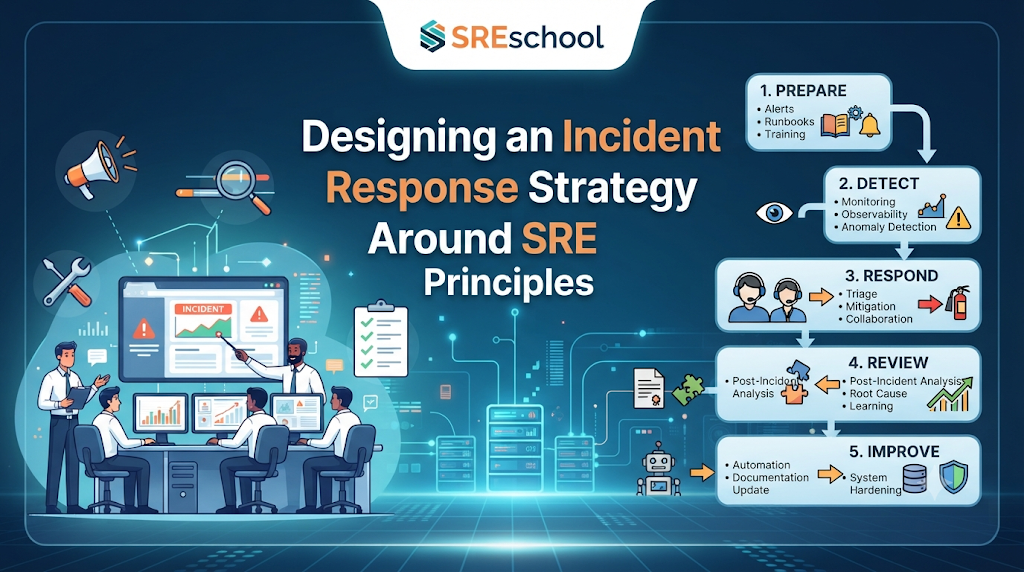
When a system breaks down, structured steps matter. Teams detect the alert, triage the severity, investigate the cause, recover the service, and review what happened.After fixing the issue, the team holds a postmortem. This is a blame-free meeting to figure out why the bug slipped through and how to stop it from happening again.
Automation and Reducing Toil
Toil is manual, repetitive work that adds no lasting value. Doing the same server setup tasks every day burns engineers out.SRE uses automation to handle routine work. However, teams must test their scripts carefully, because a poorly written automation script can break an entire system in seconds.
Capacity Planning and Cloud Reliability
As apps grow popular, servers must handle heavier loads without crashing. Capacity planning involves tracking resource usage and predicting future traffic surges.Cloud reliability means building apps that keep running even if an entire cloud data center suddenly loses power.
Distributed Systems and Production Engineering
Modern software runs across dozens of connected microservices. If one background database slows down, the front-end login page might freeze completely.Production engineering focuses on building safety nets into these complex setups so small glitches do not turn into total blackouts.
Real-World SRE Scenarios
- Traffic Surges: A shopping app slows down during a holiday sale because database queries back up. Engineers use observability tools to spot the bottleneck and scale up server limits.
- Noisy Alerts: A team gets woken up by fifty minor alerts every night, causing them to miss a real emergency. They clean up their alert rules to focus only on true user-facing issues.
- Bad Updates: A new software patch has a memory leak that crashes the app. Automated safety checks catch the error, roll back the update instantly, and trigger a postmortem review.
The Learning Ecosystem Connection
Learning SRE is a step-by-step path. Learners usually start with basic tutorials and online courses before moving on to formal training and certifications. Once certified, professionals apply those skills inside companies, backed by the right tools and concepts.
Benefits of Learning SRE
Studying Site Reliability Engineering offers clear professional advantages:
- A deeper grasp of how production systems work under pressure.
- Stronger troubleshooting and observability habits.
- Better skills for handling unexpected outages.
- Clear methods for measuring system stability.
Common SRE Mistakes to Avoid
- Studying tools too early: Focusing on software buttons before learning core reliability rules.
- Ignoring software development: Treating operations as mindless manual labor instead of writing code to fix bottlenecks.
- Creating noisy alarms: Setting up too many sensitive alerts that teach your team to ignore warnings.
- Skipping postmortems: Fixing an outage quickly without investigating why it happened in the first place.
Practical 8-Step SRE Learning Path
- Learn Basic Networking: Understand how internet data packets travel between servers.
- Study Linux Basics: Learn how operating systems manage computer memory and files.
- Explore Monitoring: Learn how to read CPU usage, memory limits, and request latency.
- Define SLOs: Practice setting realistic uptime goals for web services.
- Master Incident Response: Learn how to triage alerts calmly during an emergency.
- Adopt Automation: Write simple scripts to automate boring daily chores.
- Study Cloud Basics: Understand how scalable cloud infrastructure operates.
- Practice Postmortems: Learn how to analyze failures without pointing fingers at individuals.
Who Can Benefit from SRESchool.com?
- Students and Beginners: People starting fresh who want a solid grasp of production systems.
- Software Engineers: Developers who want to see how their code behaves in the real world.
- DevOps Engineers: Professionals looking to sharpen their automation and uptime skills.
- Platform Engineers: Teams building internal developer tools and cloud infrastructure.
- Engineering Leaders: Managers looking to align team workflows with industry reliability standards.
- Organizations: Companies building proactive SRE practices from scratch.
Trade-Offs, Limitations, and Failure Modes
SRE is not a magical cure-all for broken apps. Adopting these practices takes time, training, and a shift in company culture.Over-automating unstable workflows can cause unexpected damage. Teams must always balance the cost of cloud monitoring tools against the actual needs of their users.
Frequently Asked Questions
What is Site Reliability Engineering?
Site Reliability Engineering is a practice that uses software engineering to solve IT operations problems, helping teams run stable production systems.
What does SRE training include?
Training covers core reliability ideas like SLIs, SLOs, error budgets, system monitoring, and incident response.
Is an SRE certification mandatory to get hired?
Certifications help prove your knowledge, but hands-on experience troubleshooting live production systems is much more valuable.
What is the difference between an SLI and an SLO?
An SLI measures a specific performance metric, while an SLO is the target goal set for that metric.
What is an error budget?
An error budget is the amount of downtime allowed before a team pauses new feature updates to focus entirely on stability fixes.
What is the difference between monitoring and observability?
Monitoring tells you when a system breaks, while observability helps you inspect internal logs to find out why it broke.
How do SRE consulting services help businesses?
Consulting helps companies review their monitoring setups, define realistic uptime targets, and improve overall system maturity.
What does SRE as a Service mean?
It is a support model where external experts help manage cloud infrastructure, monitoring tools, and incident workflows.
Why are postmortems useful?
Postmortems offer a blame-free review after an outage, helping teams find root causes and prevent repeat failures.
What background do I need before learning SRE?
A basic understanding of software coding, computer networking, and operating systems provides a great starting point.
Conclusion
Keeping digital services running smoothly takes discipline, measurement, and continuous learning. Platforms like SRESchool.com help bridge the gap by offering practical training, structured courses, and expert resources for Site Reliability Engineering. By focusing on core habits like SLOs, observability, and automation, engineers can build dependable systems that users can trust.
