DevOpsSchool: A Free Guide to Learning DevOps, SRE and Platform Engineering
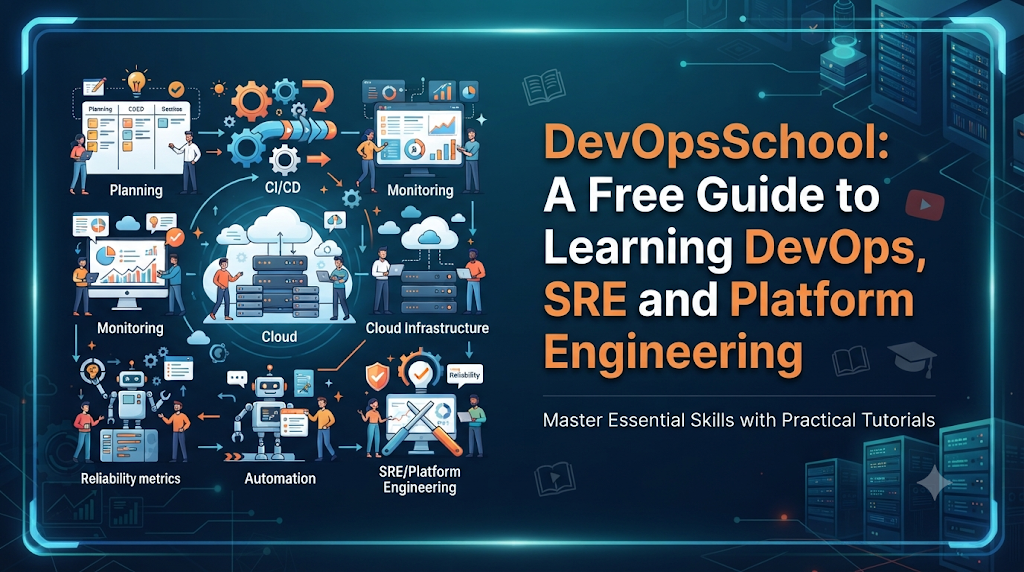
You open a video about Docker. Then someone says you need Kubernetes. Then a post says cloud is more important. Another says only certificates matter. A week later, you have ten browser tabs open and no idea what comes first.DevOps is wide. It covers code, servers, automation, cloud, monitoring and security. Beginners often ask the same questions. Which tool should I pick? When do I start cloud? Is a certificate worth the money? How do I get real practice? How do I prepare for interviews?A good DevOps roadmap answers these questions by putting the topics in a sensible order. DevOpsSchool is a platform built around that idea. This post shows what it offers, in plain words.
A Quick Look at DevOpsSchool
DevOpsSchool is a free and open platform for software and infrastructure learners. It is useful for DevOps engineers, SREs, cloud engineers, platform engineers, developers, students and people changing careers.You can think of it as a learning and career map. It brings together:
- Learning paths. Structured 90-day plans for areas like DevOps, SRE, Platform Engineering, GitOps, DevSecOps, FinOps, MLOps, AIOps, CloudOps, DataOps and SecOps. Each plan can include concepts, tools, hands-on projects, interview practice, certification tips and milestones.
- A technology directory. A place that groups and compares tools across CI/CD, Kubernetes, Infrastructure as Code, monitoring, containers, GitOps, security, cloud, incident management and automation.
- A certification registry. A research space for providers, exam codes, formats, costs, renewal needs, study material and related learning paths.
- Extra resources. Job information, a glossary, labs, tutorials and contributions from the community.
The goal is to help people find their way, not to push them toward one fixed route.
What Goes Wrong When You Learn Without a Plan
Learning without a plan feels busy, but it leaves holes. A person might know how to write a pipeline but not understand how DNS works. Another might deploy to Kubernetes but struggle with basic Linux commands when something breaks.A working engineer usually needs some knowledge of systems, networking, Git, scripting, CI/CD, containers, infrastructure code, cloud, monitoring, security and reliability. The depth differs by role. A cloud engineer may need strong networking. A platform engineer may need more Kubernetes. Nobody needs everything at expert level.That is why a DevOps learning path should match the person. It does not have to be long. It only needs a sensible order and a goal at the end.
Map First, Route Second
People often use the words roadmap and learning path as if they mean the same thing. They do not.A DevOps roadmap is like a city map. It shows all the main areas and how they connect, so you can see the whole picture.A DevOps learning path is the route you pick on that map. It depends on where you start, how many hours you have each week, and where you want to end up.A practical way to do this is to write down your goal, split the work into small weekly tasks, and attach a small project to each block. Ninety days is a good length because it is long enough to learn something real and short enough to keep going.
Skills That Add Up to a DevOps Job
Think of your skills as a ladder. Each step helps with the next one.Start with Git, so you can work with other people's code. Add scripting, so you can automate boring tasks. Learn CI/CD, so code can be tested and released without manual steps. Learn containers to package apps neatly. Study cloud and infrastructure code to create servers and networks the repeatable way. Add monitoring to watch how things behave. Keep security in mind at every step.A solid DevOps engineer roadmap follows this kind of flow, and it always includes troubleshooting. When a deployment fails at night, nobody asks what course you took. They ask whether you can find the problem. You build that ability by doing real tasks, making mistakes in a lab, and fixing them.
What Different Types of Tools Actually Do
A long list of names can feel scary. It gets easier when you ask one question: what problem does this group solve?
- Pipeline tools move code from commit to release.
- Container tools bundle an app with everything it needs.
- Kubernetes tools keep many containers running across many machines.
- Infrastructure as Code tools build servers and networks from written files.
- Monitoring tools show metrics, logs and alerts.
- Security tools check code and settings for weak spots.
- Automation tools take over repeated manual work.
When you see DevOps tools as answers to problems, you can learn one from each group and carry that thinking to others. DevOpsSchool arranges its technology directory by area, which supports this way of learning.
How to Compare Tools Without Following the Crowd
The most talked-about tool is not always the right one. A fair DevOps tools comparison asks about your situation, not about fame.
| Check This | Why It Matters |
|---|---|
| What problem it solves | A great tool for the wrong job is still wrong |
| Features | You may not need the long feature list |
| Fit with your current setup | Poor integration creates extra work |
| Time to learn | Steep learning slows the team down |
| Hosted or self-managed | Decides who does the upkeep |
| Total cost | Includes licences, hosting and people time |
| Community and docs | Help is easier when many people use it |
| Who will maintain it | Tools need updates and care |
| Team experience | Familiar ideas are faster to adopt |
| Technical limits | Scale, security and rules may rule things out |
Learners can use this table too. Add "does my target job ask for it?" as one more row.
What a Certificate Can and Cannot Do
A certificate shows you studied a subject in an organized way and passed an exam. That can help you stay on track and give employers a quick hint about your level.It cannot replace practice. Someone with a certificate but no projects may struggle when asked how they would fix a failed release. Someone with great projects and no certificate may still impress.So treat DevOps certifications as support, not as a shortcut. They work best beside real projects. No certificate can promise a job or a raise.
Choosing Exams Without Wasting Money
Picking exams because friends took them is risky. Start with your own situation, and build a DevOps certification roadmap from these questions:
- What job do I want?
- How much experience do I have today?
- Which cloud or tool area will my role use?
- What does the exam test, and in what format?
- How much does it cost in total, including study material?
- Does the certificate expire, and what is needed to renew it?
- Are there good labs and practice resources?
- Have I built something related to the exam topics?
A registry that lists providers, exam codes, formats, costs and renewal rules saves hours of searching, and it lets you compare options in one place.
When You Want to Keep Systems Running
SRE stands for Site Reliability Engineering. It overlaps with DevOps but has a sharper focus. DevOps is a wide approach to teamwork between building and running software. SRE uses engineering methods to keep live services dependable.An SRE roadmap usually leans into these topics:
- Reliability: building services that survive part failures
- Monitoring: knowing what normal looks like and spotting changes early
- Incident response: handling outages calmly and learning afterward
- Service levels: clear targets for how well a service should work
- Error budgets: how much failure is allowed before the team pauses new features to fix stability
- Less manual work: automating repeated operations
If you enjoy asking "why did this break, and how do we stop it happening again?", this direction may suit you.
Building the Road Other Developers Drive On
Picture a company with twenty teams. Each builds its own pipeline, its own cluster setup and its own scripts. The result is waste and uneven quality.Platform Engineering solves this by creating one shared internal platform. Developers use it through self-service, with standard templates and workflows. They can start a new service, get a pipeline and see dashboards without waiting on tickets. The better this works, the better the developer experience.Platform engineers also automate infrastructure and keep the platform itself reliable, since many teams rely on it. A Platform Engineering roadmap blends Kubernetes, Infrastructure as Code, CI/CD and product thinking. People who like building tools for other engineers can make this a career of its own.
Let Real Job Posts Guide Your Study
Job posts are the clearest view of what employers want. They are also uneven. One asks for cloud and Terraform. Another wants Kubernetes and monitoring. A third mentions scripting, security and pipelines.Read twenty or thirty DevOps jobs in the role you want. Note the skills that keep appearing. Those deserve your time first. Skills that appear rarely can wait.This beats following a fixed tool list that someone made years ago. Requirements also change by country and company size, so repeat this check every few months.
Five Steps You Can Follow
Step 1: Define the Career Goal
Pick a target role, such as DevOps engineer, SRE, cloud engineer or platform engineer. Each leans on different skills. A goal saves you from learning things you will never use.
Step 2: Build the Learning Foundation
Get comfortable with Linux, networking, Git and scripting. These basics make every later tool easier to understand.
Step 3: Learn Tools Through Practical Work
Choose one tool per group and use it on a real task. Set up a pipeline for a sample app, package it, deploy it with code and add monitoring.
Step 4: Add Certifications and Specialization
After you have hands-on experience, pick exams that fit your goal. Then think about a specialty such as SRE, Platform Engineering, DevSecOps or MLOps.
Step 5: Prepare for Real Engineering Work
Practice fixing broken setups in labs. Explain your projects out loud. Prepare for interviews and keep reading job posts to find gaps.
Mistakes People Make Along the Way
- Starting with the trendiest tool. Popular is not the same as right for you.
- Following a copied roadmap. Someone else's plan fits someone else's life.
- Collecting certificates but skipping projects. Employers like to hear what you built.
- Skipping the basics. Weak Linux and networking knowledge hurts later.
- Not learning to troubleshoot. Real work is mostly fixing things.
- Using a tool without knowing why. If you cannot name the problem it solves, pause.
- Believing every role is the same. A DevOps job at one company may look very different at another.
- Never reading job posts. You may end up studying the wrong things.
A Made-Up Story: Rohan the System Administrator
Rohan is a system administrator, and he is not a real DevOpsSchool learner. He spends his days restarting servers and applying patches by hand. He wants a DevOps role, but he feels behind because everyone talks about tools he has never touched.He first writes down his goal: a cloud-focused DevOps position. He already knows Linux well, so he skips that part. He fills his gaps with Git, Python scripting and cloud basics. His first project is small. He takes one manual server setup he does at work and rewrites it as code, so it can be created again in minutes.Next he adds a pipeline that tests his scripts and a simple dashboard to watch the result. He reads job posts and finds that most ask for cloud, Infrastructure as Code and CI/CD. He picks one cloud exam, and he studies it after finishing the project.Rohan did not learn more tools than other people. He learned them in an order that matched his starting point, and that removed most of his stress.
Quick Reference: Skills and Why They Matter
| Skill | Why It Helps in Real Work |
|---|---|
| Linux and Networking | Most servers and many bugs live here |
| Git | Every team shares code through it |
| Scripting | Saves time on repeated tasks |
| CI/CD | Makes releases safe and repeatable |
| Containers | Apps run the same everywhere |
| Cloud | Where most modern systems run |
| Infrastructure as Code | Rebuilds systems without manual steps |
| Monitoring | Shows problems before users report them |
| Security | Stops weak spots from reaching production |
Questions Readers Often Ask
What kind of platform is DevOpsSchool?
It is a free and open space for learning and career planning in DevOps, SRE, Platform Engineering and similar fields. It combines learning paths, tool research, certification information, job resources and labs.
Do I need coding skills before starting?
Basic scripting helps a lot, but you can build it as you go. Comfort with the command line matters more at the start.
Why is a path better than a list of tools?
A list only names things. A path gives you an order, projects to build and checkpoints to measure progress.
How do I pick a tool?
Start with the problem you need to solve. Then compare cost, fit, learning time and community support.
Is a certificate required to get hired?
Not always. Some employers like them, while others look mainly at experience and projects.
How do I decide which exam to take?
Match it to your goal and your current level. Check the cost, format and renewal rules first.
Is SRE just another name for DevOps?
No. They share ideas, but SRE puts extra weight on service reliability, targets and incident handling.
What does a platform engineer build?
Shared internal platforms that help developers ship software faster through standard, self-service workflows.
How long does it take to become job-ready?
It depends on your background and weekly hours. A structured 90-day plan can give you a strong start, but steady practice beyond that matters.
How do I get ready for interviews?
Build two or three solid projects, practice troubleshooting, and be ready to explain your choices simply.
Conclusion
If you remember only a few things from this post, let them be these:
- Pick a goal before picking tools.
- Learn the basics, even when they feel slow.
- Build something small for every new skill.
- Choose tools by the problem, not the buzz.
- Add certificates after you have real practice.
- Check job posts often.
DevOpsSchool puts learning paths, tool research, certification details, job resources and engineering guidance in one open place, which makes planning easier for people at any starting point.
