Expert Strategies for Scoring High on Austria Red‑White‑Red Card Points
 Introduction
Moving to a new country is a massive decision, and it’s natural to feel a bit overwhelmed by the bureaucracy. If you are eyeing Austria, you have likely heard about the Red-White-Red Card. It is the golden ticket for skilled professionals who want to build a life in the heart of Europe. But before you start packing, you need to understand the "points" game. Think of it less like a rigid exam and more like a roadmap that tells the Austrian government who you are, what you bring to the table, and why you would be a great addition to their workforce.
What is the Austria PR Points Calculator?
The Austria PR points calculator is essentially a self-assessment tool designed to help you gauge your chances of qualifying for a Red-White-Red (RWR) Card. Austria uses a points-based immigration system to ensure they attract talent that meets specific labor market needs.
Why does it matter?
It matters because it provides clarity. Instead of guessing whether your skills or experience are enough, this system gives you a numerical score based on objective factors like your education, age, language skills, and professional background. It is your first step toward realistic planning—if you know where you stand, you know exactly what you need to improve to hit the minimum requirements.
How does it work?
It is quite straightforward. You choose a "route" based on your professional profile (like Very Highly Qualified, Shortage Occupation, etc.), and the system assigns points for specific achievements. For example, a higher degree might give you more points than a diploma, and being younger usually racks up more points than being older. You tally your score, compare it to the required threshold for your chosen category, and see if you meet the bar.
Understanding Eligibility
- Minimum points required: Every category has a pass mark. You must hit this to be considered.
- Language skills: Whether it is German or English, proving you can communicate is vital.
- Work experience: Your professional history, especially if it was in Austria, carries significant weight.
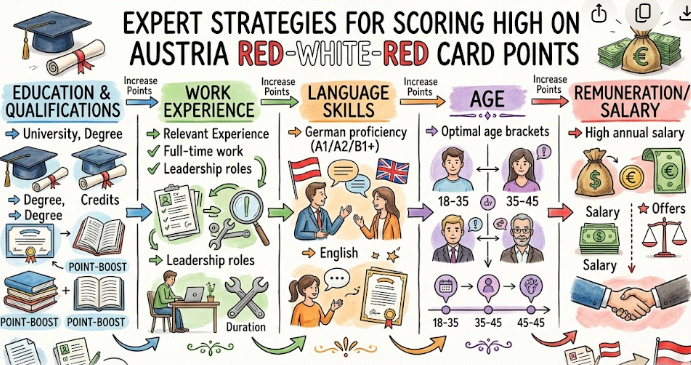
- Age factor: Younger applicants often gain more points, acknowledging their potential for a longer working career in the country.
- Education benefits: Higher education degrees—especially in MINT (Mathematics, Informatics, Natural Sciences, Technology) fields—can be a game-changer for your score.
How to Increase Your Austria PR Points
If you find yourself a few points shy of the target, don’t lose heart. There are strategic ways to boost your profile:
- Language Proficiency: This is often the most accessible way to gain points. If you are at an A1 level, aim for A2 or B1. Adding a language certification can quickly bridge the gap.
- Upskilling: Check if your current qualifications can be bolstered by a specialized certification or a post-graduate diploma.
- Gain Relevant Experience: If you are currently working, focus on roles that align with "shortage occupations." Every bit of experience counts toward your total.
- Target the Right Category: Sometimes, people focus on the wrong route. Research the "Shortage Occupation List" annually—your specific role might be in high demand, automatically making your profile more competitive.
Step-by-Step Guide to Calculate Your Austria PR Points
- Pick your route: Identify whether you fall under "Very Highly Qualified," "Shortage Occupations," "Other Key Workers," or "Start-up Founders."
- Gather your documents: Have your degrees, job letters, and language certificates ready. You cannot claim points you cannot prove.
- Use the official calculator: Access the official tool and input your details honestly.
- Review the criteria: Check not just the points, but the mandatory conditions (like salary thresholds) that don't give points but are essential for approval.
- Verify your score: Double-check your math against the official tables to ensure you meet the minimum requirement.
Common Mistakes to Avoid:
- Ignoring the Salary Threshold: You might have enough points, but if the job offer doesn’t meet the minimum salary requirement for your category, the application will fail.
- Overestimating Language Levels: Only claim points for the level you can officially certify.
- Missing Documentation: Ensure every year of work experience is backed by clear, verifiable letters.
Important Documents:
- Valid Passport.
- Degrees, diplomas, and transcripts (often need to be legalized/apostilled).
- Official language test certificates.
- Proof of work experience (reference letters).
- Job offer letter from an Austrian employer (if applicable).
Austria PR Routes & Points Comparison
| Route | Minimum Points | Key Focus |
| Very Highly Qualified | 70 | High academic/specialized talent |
| Shortage Occupations | 55 | Specific skills in high demand |
| Other Key Workers | 55 | General professional expertise |
| Start-up Founders | 50 | Business potential/investment |
Points Distribution Summary
| Category | Typical Max Points |
| Qualification | 30 - 40 |
| Work Experience | 20 |
| Language Skills | 10 - 25 |
| Age | 15 - 20 |
Real Stories from the Field
- Ravi’s Journey: When I first checked my points, I was five points short. I was an IT engineer, but my German was only at a basic level. I spent six months taking intensive evening classes to reach B1. That extra effort pushed my score over the threshold, and I finally got my RWR card last year. It was a grind, but holding that card made it all worth it.
- Anjali’s Success: I thought I didn't have enough experience, but after looking at the Shortage Occupations list, I realized my specific niche in clinical research was highly valued in Austria. I focused my application on that, rather than general management, and it made the difference. Don't underestimate how much knowing your specific category helps.
Why Austria?
- High Quality of Life: Consistently ranked among the best in the world.
- Strong Economy: Great job security and work-life balance.
- Gateway to Europe: A central location that makes travel easy.
- Clear Pathway: A transparent system that rewards skill and dedication.
Understanding the points system is the difference between hoping for a chance and actively building one. It turns a vague dream into a concrete project.
Frequently Asked Questions
- Do I need a job offer to calculate my points?It depends on the category. Some routes, like Very Highly Qualified, allow you to apply for a job seeker visa first.
- Can I add points for my spouse’s qualifications?Generally, no; the points are assessed based on your own individual profile.
- Is English enough?For some roles, yes, especially in international companies, but German is highly recommended for integration and long-term success.
- How often does the shortage list change?The list is reviewed and updated annually based on market needs.
- What if my degree is from outside Europe?It can still be valid, but you may need to go through a recognition process to prove its equivalence.
- Are these points permanent?No, they are for your initial application. Once you have your card, you focus on your career and residency requirements.
- Does age really matter that much?Yes, the system favors younger professionals who have more years to contribute to the economy.
- What happens after 24 months?You can typically apply for a Red-White-Red Card Plus, which gives you unrestricted access to the labor market.
- Can I use the calculator for my family?The calculator is for the main applicant. Family members usually join via family reunification.
- Where is the official calculator?Always use the official Migration.gv.at portal to ensure you are looking at the most current rules.
Conclusion
Starting your journey to Austria is a bold move, and the points system is your most valuable tool for preparation. Take the time to calculate your points accurately, identify the areas where you can grow, and prepare your documentation with care. You are not just filling out a form; you are drafting the blueprint for your future.
