Master Core Concepts and Applications Through AIOps Foundation Certification
 Introduction
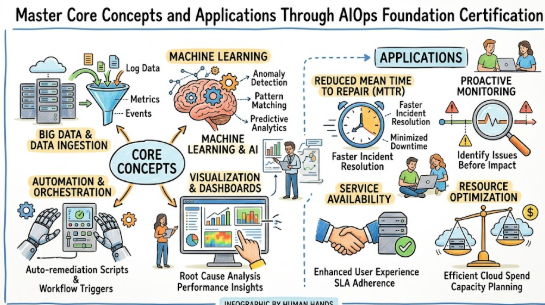
The complexity of modern enterprise infrastructure is scaling beyond human capability. With microservices architectures, hybrid cloud platforms, and endless streams of telemetry data, traditional monitoring tools are failing to keep pace. IT operations teams find themselves buried under an overwhelming amount of alert noise, making it difficult to isolate root causes when critical outages occur. This is why Artificial Intelligence for IT Operations, known as AIOps, is becoming the standard for modern system reliability. The shift toward intelligent, automated operations is forcing software engineers, site reliability engineers, and engineering managers to upgrade their skills. Organizations need professionals who understand how to apply machine learning algorithms to logs, metrics, and traces. The entry point for this transition is a structured validation program. This master-level guide provides a complete overview of how this specific foundation program helps professionals transition from manual system monitoring to intelligent operational automation.
What is AIOps Foundation Certification
The AIOps Foundation Certification is an entry-level credential designed to validate a professional's understanding of how artificial intelligence and machine learning are integrated into IT operations. The program confirms your grasp of core principles like machine learning lifecycle models, automatic event correlation, data ingestion strategies, and predictive analytics. This program bridges the gap between pure data science and everyday system administration. It is not a pure coding program where you build algorithms from scratch. Instead, it focuses on how to leverage existing AI models to process large scale telemetry, reduce alert fatigue, and establish the building blocks for autonomous, self-healing software infrastructures.
Why it matters today?
Enterprises face an unprecedented volume of data generated by cloud-native systems. Human operators can no longer sit in front of dashboards watching graphs to catch anomalies. Manual inspection leads to slow incident response times, high mean time to resolution, and severe business downtime.AIOps matters because it introduces data-driven intelligence into monitoring pipelines. It allows systems to automatically group related warning signals, separate critical anomalies from standard background noise, and flag emerging performance bottlenecks before they impact end users.For technical teams, mastering this domain means shifting from a stressful, reactive fire-fighting loop to a proactive operational posture.
Why AIOps Foundation Certification certifications are important
Earning a formal certification establishes a standardized baseline of knowledge across complex, multidisciplinary engineering teams. Because AIOps combines elements of data engineering, cloud architecture, and operations, professionals often have gaps in their understanding of the complete lifecycle.A structured certification ensures that you understand the entire workflow, from data ingestion across multi-cloud environments to setting up autonomous remediation playbooks. For engineers in competitive regional and global job markets, this credential serves as verifiable proof that you possess the modern skills required to manage complex, automated infrastructure environments.
Why choose AIOps School?
AIOps School stands out as a specialized, premium training and certification platform dedicated exclusively to artificial intelligence and machine learning operations within IT ecosystems. Unlike general cloud training providers, their curriculum focuses entirely on practical operational intelligence. The learning materials are designed by industry practitioners who actively manage large-scale automated environments, ensuring that the theoretical concepts map directly to real-world deployment scenarios.The certification programs at AIOps School are backed by structured, hands-on sandbox labs where engineers can interact with actual system datasets, run correlation models, and practice setting up automated anomaly detection workflows.This specialized focus gives candidates a deeper, more comprehensive understanding of modern infrastructure automation than standard multi-topic training platforms.
Certification Deep-Dive
What is this certification?
The AIOps Foundation Certification is the definitive entry-level credential for professionals seeking to understand how machine learning and big data analytics are applied to optimize and automate modern IT operations.
Who should take this certification?
This certification is designed for software engineers, DevOps specialists, cloud engineers, site reliability engineers, platform administrators, and technical managers who want to build a solid foundational understanding of intelligent infrastructure automation.
Certification Overview Table
| Track | Level | Who it’s for | Prerequisites | Skills Covered | Recommended Order |
| AIOps Track | Foundation | Beginners, System Admins | Basic IT Ops Concepts | Event Correlation, ML Basics, Predictive Analytics | First |
| AIOps Track | Engineer | Operational Engineers | Foundation Certified | Anomaly Detection, Auto-Remediation, Pipeline Setup | Second |
| AIOps Track | Professional | Senior DevOps / SRE | Production Engineering | Enterprise Implementation, Large Scale Architecture | Third |
| AIOps Track | Architect | Systems Architects | Expert Operations | ML Infrastructure, Global Scale System Design | Fourth |
Skills you will gain
- Deep understanding of basic machine learning concepts like supervised and unsupervised learning applied to systems data.
- Ability to implement automated event correlation techniques to reduce alert noise across distributed services.
- Core knowledge of time-series forecasting models used for proactive capacity planning and bottleneck prediction.
- Fundamental mechanics of self-healing systems, autonomous feedback loops, and automated runbook executions.
- Proficiency in handling big data characteristics, specifically managing the high volume and velocity of modern system telemetry.
Real-world projects you should be able to do after this certification
- Configure an event correlation system that automatically groups hundred of scattered alerts into a single, actionable incident ticket.
- Build a proactive performance monitoring model that uses historical metrics to predict system capacity overloads hours before they happen.
- Design a basic automated remediation pipeline that triggers a self-healing script to clear disk space or reboot services when specific patterns are caught.
- Set up an intelligent anomaly detection rule on a log aggregation tool to flag unexpected payload variations without setting rigid, static thresholds.
Preparation plan
7–14 days plan
Focus your effort entirely on core theory and structural definitions. Spend the first five days learning the evolution of IT operations, the five variables of big data, and how algorithmic models differ from standard analytics. Use the remaining days to study the exam blueprint, take official practice questions, and review event correlation structures.
30 days plan
Dedicate two hours every day to achieve a well-rounded understanding. Spend the first two weeks exploring machine learning models, log processing formats, and predictive analytics theory. Use the third week to perform the official hands-on sandbox labs, working with sample telemetry datasets. Use the final week to review weak spots and take simulated practice exams.
60 days plan
An ideal approach for busy working professionals. Spend the first month carefully reading the complete resource library, understanding the distinct operational metrics, and mapping out how AIOps impacts different parts of an enterprise organization. Dedicate the second month to rigorous practical lab configurations, building automated alerts, studying advanced autonomous remediation design patterns, and taking weekly evaluation quizzes.
Common mistakes to avoid
- Overlooking the basic data engineering concepts, assuming that the certification only tests high-level automation theories.
- Attempting the online exam without walking through the practical sandbox labs to see how algorithms process sample metrics.
- Relying on static, traditional monitoring mindsets instead of embracing dynamic, algorithmic-driven threshold concepts.
- Skipping the official practice question sets, which helps you understand the specific framing of the multiple-choice scenario questions.
Best next certification after this
Same track
The natural next step is the AIOps Engineer Certification, which transitions your knowledge from fundamental concepts into building and maintaining actual anomaly detection algorithms in active production environments.
Cross-track
The Certified MLOps Foundation program is an excellent cross-track choice, allowing you to learn how to manage, deploy, and monitor the actual machine learning models that support smart software products.
Leadership / management
The IT Operations Strategy Manager certification provides a fantastic path for professionals who want to lead technical transformations, manage engineering teams, and oversee the financial scaling of automated platforms.
Choose Your Learning Path
DevOps Path
This path centers on integrating intelligent automation directly into the continuous integration and continuous deployment software pipelines. It is designed for engineers who want to use machine learning to analyze build logs, automate testing gates, and catch deployment anomalies before code reaches customer environments.
DevSecOps Path
A path focused on embedding automated security scanners and policy-as-code checks into development pipelines. This track is ideal for security-minded practitioners who want to use automated pattern recognition to spot vulnerabilities, detect active infrastructure threats, and ensure compliance without slowing down feature delivery.
Site Reliability Engineering (SRE) Path
This track targets the stabilization and resilience of large-scale production environments. It is best suited for engineers who focus on maximizing system availability, managing error budgets, and using algorithmic event correlation to lower the mean time to repair during major unexpected outages.
AIOps / MLOps Path
The definitive path for professionals specializing in data science infrastructure and operational artificial intelligence. This is ideal for specialists who want to master the lifecycle of machine learning models, build highly scalable data pipelines, and design autonomous self-healing software platforms.
DataOps Path
A path tailored around bringing agility, quality, and continuous integration practices to data pipelines. It is best for data engineers and pipeline architects who manage large analytics frameworks, data warehouses, and automated data processing streams across enterprise systems.
FinOps Path
This track focuses on the financial optimization and cloud spending efficiency of corporate IT systems. It is designed for professionals who want to use machine learning models to analyze usage trends, predict future infrastructure costs, and automate cloud resource allocation to reduce waste.
Role → Recommended Certifications Mapping in table
| Role | Recommended Certifications |
| DevOps Engineer | AIOps Foundation Certification, DevOps Professional |
| Site Reliability Engineer (SRE) | AIOps Foundation Certification, Certified SRE |
| Platform Engineer | AIOps Foundation Certification, Cloud Architecture Expert |
| Cloud Engineer | AIOps Foundation Certification, Cloud Infrastructure Specialist |
| Security Engineer | AIOps Foundation Certification, DevSecOps Engineer Specialist |
| Data Engineer | AIOps Foundation Certification, DataOps Master |
| FinOps Practitioner | AIOps Foundation Certification, Cloud Financial Controller |
| Engineering Manager | AIOps Foundation Certification, Strategic IT Director |
Next Certifications to Take
One same-track certification
The Certified AIOps Engineer program serves as the direct next milestone within the intelligent operations ecosystem, expanding your fundamental theory into advanced practical areas like designing automated remediation runbooks and configuring production-grade anomaly detection pipelines.
One cross-track certification
The Certified MLOps Engineer credential acts as a highly valuable cross-disciplinary track, equipping you with the specialized skills needed to manage continuous integration, model versioning, and continuous deployment workflows for production-ready machine learning algorithms.
One leadership-focused certification
The Enterprise Technology Infrastructure Director program is the premium path for career progression into senior leadership, teaching you how to build engineering team structures, oversee regional and global digital transformations, and align technical automation investments with major corporate financial goals.
Training & Certification Support Institutions
DevOpsSchool
DevOpsSchool is a prominent training organization recognized for delivering deep, instructor-led technical bootcamps across a wide spectrum of cloud-native and automation practices. Their structured programs emphasize intensive hands-on lab sessions, providing corporate teams and individual engineers with real-world project experience that aligns closely with modern global hiring requirements.
Cotocus
Cotocus specializes in delivering premium technical consulting and tailored certification training programs for advanced IT operations sectors. Their curriculum delivery focuses heavily on modern platform engineering, container orchestration setups, and practical deployment mechanics, ensuring that candidates understand how to apply theoretical frameworks to actual production environments.
ScmGalaxy
ScmGalaxy serves as a comprehensive educational resource hub, community forum, and technical training provider focused on configuration management, build automation, and continuous delivery tools. The platform offers deep technical articles, step-by-step video tutorials, and expert-led certification support sessions designed to help software engineers upgrade their day-to-day deployment skills.
BestDevOps
BestDevOps focuses on providing targeted, accelerated training solutions and exam preparation modules for essential cloud-native certifications. Their platform offers simplified learning guides, simulated mock testing environments, and direct mentorship support to help technical professionals navigate their learning journeys and clear engineering assessments efficiently.
devsecopsschool.com
This institution is dedicated entirely to the core disciplines of automated infrastructure security and policy enforcement within deployment workflows. Their specialized courses teach engineers how to shift security checks left, configure continuous vulnerability scanning tools, and build resilient, hardened cloud infrastructure platforms.
sreschool.com
sreschool.com offers focused, practical curriculum paths dedicated to the concepts of modern site reliability engineering and production system stability. The training focuses on managing service level objectives, optimizing error budgets, configuring advanced distributed tracing tools, and mastering high-availability architecture patterns.
aiopsschool.com
As the leading domain-specific educational platform, aiopsschool.com delivers comprehensive training paths focused on the convergence of machine learning and system operations. Their courses cover everything from baseline big data characteristics to enterprise-scale autonomous remediation frameworks, supported by custom analytics sandbox environments.
dataopsschool.com
This specialized training portal addresses the structural and operational needs of modern data engineering pipelines and analytics architectures. The learning tracks help data professionals apply DevOps principles like automated testing, continuous integration, and quality monitoring directly to complex data workflows.
finopsschool.com
finopsschool.com provides structured financial management training courses tailored specifically for cloud-native infrastructure scaling. Their programs teach engineering managers and financial practitioners how to leverage automated consumption data, track cloud resource waste, and implement data-driven budgeting strategies.
FAQs Section
What is the relative difficulty level of this foundational assessment?
The exam is designed to be highly accessible for entry-level professionals and experienced engineers alike, focusing on core concepts, architectural models, and operational logic rather than requiring complex mathematical calculations or code compilation.
What is the typical time required to properly prepare for the exam?
Most working software engineers and platform administrators successfully pass the assessment by dedicating approximately two to three weeks of consistent study, allowing adequate time to review the text modules and complete the practical lab exercises.
Are there any strict academic or professional prerequisites required before registration?
There are no formal certifications or work experience prerequisites required to take the exam, though possessing a baseline familiarity with basic IT infrastructure monitoring and general cloud concepts will certainly help you progress through the modules faster.
What is the recommended certification sequence to follow for long-term growth?
Candidates should ideally start with this foundation credential to master the core terminology, progress immediately to the operational engineer level for implementation skills, and eventually pursue the professional and architect credentials to master enterprise system design.
What clear career value does this specific credential bring to a technical resume?
Possessing this certified credential signals to corporate recruiters and engineering directors that you understand how to leverage artificial intelligence to solve alert fatigue and scale infrastructure efficiently, giving you a competitive advantage for modern operations roles.
Which specific job roles and growth paths open up after completing the course?
The program establishes a direct path toward specialized modern roles such as junior AIOps engineer, site reliability engineer, monitoring automation specialist, and platform analyst, which command significantly higher salary scales across global tech sectors.
Is the examination delivered in an online format or at physical testing hubs?
The evaluation is managed through a fully proctored online platform, allowing candidates to schedule and take the multiple-choice exam from any quiet location equipped with a computer, functional webcam, and stable internet connection.
Does this operational credential carry an expiration date or require renewal fees?
The certification comes with permanent, lifetime validity once you pass the assessment, meaning there are no mandatory annual maintenance fees or recurring re-certification exams required to keep your credential active.
What specific passing score must be achieved to earn the digital credential badge?
The formal examination consists of 60 multiple-choice questions that must be completed within a 90-minute limit, and candidates are required to answer at least 70% of the questions correctly to pass.
What happens if an applicant fails to achieve the passing score on their first try?
If the required passing score is not achieved, candidates are permitted to register for a retake exam after a standard 14-day study waiting period, during which you retain full access to all your training materials.
Are the hands-on practice sandbox labs included in the baseline certification bundle?
Yes, full access to the interactive practical sandbox labs is bundled directly with the standard certification package, allowing you to gain experience with actual system datasets without paying separate platform fees.
Is this validation program recognized by enterprise organizations outside of India?
The credential program is fully standardized and globally accepted across international tech hubs, cloud providers, financial corporations, and healthcare IT sectors, making it highly valuable for international career moves.
How exactly does the AIOps Foundation Certification differ from a basic data science credential?
This specific program is explicitly optimized for infrastructure engineering workflows, focusing on analyzing operational data like log files, metrics, and cloud traces, whereas traditional data science credentials focus on general statistical analysis and business consumer trends.
What primary data structures are examined within the data ingestion modules of the program?
The training modules focus heavily on the collection, standardization, and processing behavior of the three main pillars of modern observability telemetry, which are structured log data, time-series performance metrics, and distributed microservices traces.
How does the curriculum address the concept of alert fatigue inside a network operations center?
The curriculum teaches decision-makers how machine learning algorithms analyze historical alerts, establish contextual relationships between separate systems, and automatically group hundreds of scattered notification alerts into a single actionable incident ticket.
Can a non-technical engineering manager benefit from completing this foundation course?
Yes, the course is highly valuable for strategic leaders and engineering managers because it provides the structural vocabulary, implementation frameworks, and performance metrics needed to plan automation budgets and direct technical operations teams.
What specific machine learning category is most frequently leveraged for system anomaly detection?
The training modules explain how unsupervised machine learning algorithms are utilized to observe normal system behavior patterns over time, allowing the system to flag unusual performance spikes without requiring human engineers to maintain manual static thresholds.
How is the concept of autonomous remediation structured within the self-healing systems framework?
The framework outlines a continuous automated feedback loop where an anomaly triggers a specific machine learning evaluation, matches the issue against known patterns, and immediately executes an automated runbook script to resolve the incident without manual intervention.
What specific business metrics are utilized to evaluate the success of an AIOps deployment?
The course material highlights key operational performance indicators such as a measurable reduction in total alert noise volume, a significant decrease in the mean time to detect incidents, and a drastic minimization of unexpected system downtime.
How does the program address the integration of legacy infrastructure with modern cloud automation?
The curriculum provides strategic insight into deploying intermediate data collection agents and log forwarders that wrap around older legacy systems, allowing their output to be normalized and successfully processed by modern centralized AI platforms.
Testimonials
Rajesh
The baseline concepts taught in this course helped me understand exactly how machine learning applies to standard system telemetry. My day-to-day work became much more organized once I learned to configure automated event correlation models.
Sarah
Managing distributed cloud services was becoming impossible due to constant alert fatigue across our dashboards. This certification provided clear structural knowledge that allowed me to implement smart anomaly detection and reduce noise by over sixty percent.
Amit
I wanted a clear roadmap to transition from traditional system administration into modern platform engineering. The preparation plan gave me complete clarity on how data pipelines function, which immediately boosted my performance during complex system reviews.
Vikram
As a security specialist, understanding infrastructure patterns is critical to catching active network threats early. This program significantly elevated my confidence in setting up automated security feedback loops within our main continuous deployment streams.
Elena
This training equipped me with the specific vocabulary and performance metrics required to justify automation investments to executive boards. I can now guide my engineering teams toward intelligent operations with high strategic clarity and confidence.
Conclusion
The evolution of modern IT infrastructure requires a fundamental shift in how engineering teams manage system reliability. As systems grow more complex, relying on manual monitoring lines and static thresholds is no longer a viable option for growing enterprises.The AIOps Foundation Certification offers a clear, highly structured pathway for professionals to master the principles of machine learning operations and automated incident resolution. Investing in this certification provides significant long-term benefits for your technical career, positioning you at the forefront of the modern platform engineering space. By establishing a solid baseline in event correlation, predictive analytics, and self-healing system design, you ensure your skills remain highly valuable in an increasingly automated global job market. Planning your learning path today is the most strategic step toward leading the next generation of intelligent infrastructure operations.
