Practical Techniques for Managing Reliability as a Certified Site Reliability Engineer
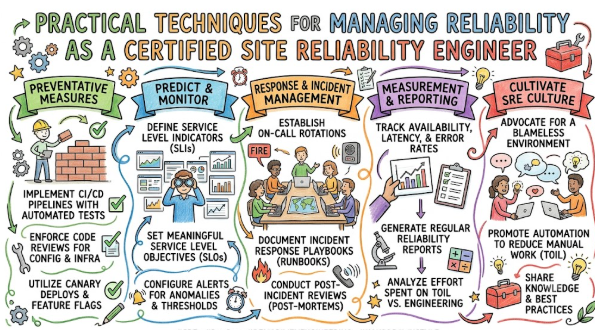 Introduction
Production environments are growing more complex every day. Microservices, cloud infrastructure, and rapid deployment cycles make system stability a massive challenge. Traditional operations models can no longer keep up with these changes. Software engineers and operations teams are expected to keep services up and running smoothly without slowing down the release of new features. This balance is exactly where Site Reliability Engineering becomes necessary.The shift from manual firefighting to automated, proactive systems engineering has changed how companies operate. This master-level guide explores the professional landscape of the Certified Site Reliability Engineer program. By focusing on modern engineering principles, this guide maps out the certification pathways, practical learning steps, and career outcomes designed to help engineering professionals excel in global technology markets.
What is Certified Site Reliability Engineer
The Certified Site Reliability Engineer program is a professional credential designed to validate an engineer’s ability to apply software engineering mindsets directly to infrastructure and operations challenges. It bridges the gap between theoretical reliability books and the actual, day-to-day management of complex distributed production environments.This certification focuses on practical application rather than simple tool memorization. It ensures that a professional can accurately measure service health, build scalable systems, and handle incident management with data-driven confidence. It serves as a global benchmark for proving that an engineer can successfully balance system uptime with software delivery speed.
Why it matters today’s ?
In modern IT architecture, even a few minutes of downtime can result in massive financial loss and damage to a brand's reputation. Systems must be resilient enough to handle unpredictable traffic spikes and infrastructure failures automatically.Traditional infrastructure management relies on manual monitoring and reactive fixes, which creates a huge amount of operational toil. Companies around the world are looking for engineers who can write code to automate these operational tasks. Becoming a certified professional proves that you know how to build self-healing systems, manage risks using metrics, and ensure high availability for applications.
Why Certified Site Reliability Engineer certifications are important
Acquiring a professional certification provides a structured path to mastering production engineering. It provides engineers with a standard framework to address system failures and measure performance objectively.
why choose SRESchool ?
SRESchool is entirely dedicated to the domain of production engineering and reliability tracking. Unlike general training platforms that cover generic IT topics, the curriculum here is crafted by seasoned infrastructure experts. The training programs move past simple multiple-choice questions, focusing instead on deep scenario-based learning and hands-on laboratory exercises.The learning platform provides real-world case studies of complex system failures to teach practical problem-solving. It offers a structured, multi-tier certification journey that scales naturally with your professional growth. By focusing on fundamental engineering patterns rather than temporary tools, SRESchool ensures your skills remain relevant across multi-cloud and hybrid environments.
Certification Deep-Dive
What is this certification?
This entry-level certification validates a fundamental understanding of SRE terminology, philosophy, and the basic metrics used to measure service health. It establishes a baseline for how engineering teams should view reliability as a shared responsibility across the organization.
Who should take this certification?
This certification is ideal for junior developers, system administrators transitioning to SRE roles, cloud engineers, and technical managers who need to oversee production systems.
Certification Overview Table
| Track | Level | Who it’s for | Prerequisites | Skills Covered | Recommended Order |
| SRE Core | Foundation | Associate Engineers | Basic Linux & Cloud | SLIs, SLOs, Toil, Error Budgets | 1 |
| SRE Core | Professional | Senior Engineers | Foundation Cert | Automation, Observability, Incident Response | 2 |
| SRE Core | Advanced | Lead Engineers | Professional Cert | Capacity Planning, Architecture, Chaos Engineering | 3 |
| FinOps | Specialist | Cloud Economists | Foundation Cert | Cloud Cost Optimization, Budget Tracking | 4 |
| DevSecOps | Specialist | Security Engineers | Foundation Cert | Resilience, Security Automation, Vulnerability Mapping | 4 |
Skills you will gain
- Mastery of core SRE metrics including Service Level Indicators (SLIs) and Service Level Objectives (SLOs).
- Ability to calculate and manage Error Budgets to balance feature releases with platform stability.
- Identification and reduction of manual operational toil through scripting and automation frameworks.
- Deep understanding of the pillars of observability, specifically logs, metrics, and distributed tracing.
- Knowledge of structuring effective incident response pipelines and establishing blameless post-mortem cultures.
Real-world projects you should be able to do after this certification
- Draft a comprehensive SLO document and error budget policy for a production microservice application.
- Create an operational dashboard displaying the four golden signals: latency, traffic, errors, and saturation.
- Conduct a mock blameless post-mortem analysis for a major service outage and document corrective actions.
- Automate a recurring, manual infrastructure maintenance task using Python or shell scripting.
Preparation plan
7–14 days plan
Focus completely on the core architectural concepts and definitions found in official reliability guides. Memorize the mathematical formulas for calculating availability and error budgets, and understand the core cultural differences between DevOps and SRE.
30 days plan
Engage directly with local or cloud-based lab environments to set up basic metrics monitoring. Practice configuring simple thresholds and alerts for web services, and review real-world case studies detailing past enterprise system outages.
60 days plan
Design a complete simulation of a service failure to practice guided incident response. Review practice exam questions to ensure conceptual clarity, and perform a mini-audit of an existing infrastructure stack to draft a toil-reduction strategy.
Common mistakes to avoid
- Focusing Only on Tools: Do not just learn specific monitoring tools; focus heavily on understanding the underlying metrics and reliability principles.
- Ignoring the Culture: SRE requires a cultural shift toward shared risk; ignoring the human and organizational aspects will lead to project failure.
- Setting Unrealistic SLOs: Avoid aiming for 100% uptime, as this is too expensive and slows down software development unnecessarily.
Best next certification after this
Same track
Certified Site Reliability Engineer - Professional Level
Cross-track
Certified DevOps Professional
Leadership / management
SRE Team Lead Fundamentals
Choose Your Learning Path
DevOps
This pathway centers on optimizing the software delivery pipeline. It teaches engineers how to embed automated testing, configuration management, and infrastructure deployment directly into continuous integration workflows to ensure deployment speed matches reliability.
DevSecOps
Designed specifically for integrating security validation directly into automated pipelines. This path focuses on shifting security to the left, ensuring vulnerability scanning, compliance monitoring, and access management are handled programmatically without slowing down operations.
Site Reliability Engineering (SRE)
The pure engineering track focused on platform stability and systems mechanics. This path goes deep into operating system internals, distributed systems architecture, advanced observability, and capacity planning for highly available applications.
AIOps / MLOps
This specialty track addresses the reliability of machine learning workflows and automated data operations. It focuses on unique production challenges such as tracking data drift, model decay, and automating retraining pipelines safely.
DataOps
Focused entirely on the reliability of big data pipelines and distributed databases. Engineers on this path learn to monitor data quality, manage schema migrations under high traffic, and maintain high availability for analytical platforms.
FinOps
This path blends financial accountability with cloud infrastructure engineering. It trains professionals to track cloud spending accurately, discover infrastructure resource waste, and implement automated cost-saving measures across multi-cloud environments.
Role → Recommended Certifications Mapping in table
| Role | Recommended Certifications |
| DevOps Engineer | Certified SRE Foundation, Certified DevOps Professional |
| Site Reliability Engineer (SRE) | Certified SRE Professional, Certified SRE Advanced |
| Platform Engineer | Certified SRE Professional, Certified Kubernetes Expert |
| Cloud Engineer | Certified SRE Foundation, CSRE Associate |
| Security Engineer | Certified SRE Foundation, DevSecOps Specialist |
| Data Engineer | Certified SRE Foundation, DataOps Specialist |
| FinOps Practitioner | Certified SRE Foundation, FinOps Specialist |
| Engineering Manager | Certified SRE Foundation, SRE Leadership Fundamentals |
Next Certifications to Take
One same-track certification can be pursued through the Certified SRE Professional level, which moves past basic terms to validate an engineer's technical ability to build real-world observability frameworks and automated self-healing workflows.
One cross-track certification can be completed through the Certified DevOps Professional program, focusing heavily on continuous delivery models and teaching professionals how to bridge software development pipelines with resilient system deployments.
One leadership-focused certification can be achieved via the SRE Leadership Fundamentals course, which prepares senior engineers to manage incident response teams, establish blameless cultures, and align reliability metrics with executive business goals.
Training & Certification Support Institutions
DevOpsSchool
This global platform is widely recognized for its intensive, expert-led training bootcamps focused on cloud-native tech and automation. It delivers structured learning programs that combine theoretical system principles with extensive lab workshops to prepare candidates thoroughly for professional certification exams.
Cotocus
Specializing in specialized corporate training and system integration solutions, this institution delivers customized educational programs for engineering teams. Its curriculum emphasizes practical infrastructure patterns and modern deployment strategies designed to resolve real-world enterprise operational challenges.
ScmGalaxy
A comprehensive community and educational portal focused heavily on configuration management, build automation, and platform engineering. It serves as an informative knowledge base filled with technical tutorials, tool guides, and step-by-step assembly instructions for infrastructure professionals.
BestDevOps
This specialized training center provides direct, practical roadmaps for mastering modern continuous delivery and site reliability practices. Its learning tracks are designed specifically to help working software developers and system administrators transition smoothly into senior infrastructure roles.
devsecopsschool.com
An educational platform dedicated entirely to security automation and modern DevSecOps methodologies. The courses instruct engineers on how to build automated compliance checks and integrate vulnerability scanners directly into continuous delivery software pipelines.
sreschool.com
The primary certification and learning portal focused exclusively on the discipline of site reliability engineering. It hosts official documentation, multi-tiered certification programs, and scenario-based simulation labs to help engineers master distributed systems reliability.
aiopsschool.com
This online academy focuses on the intersection of artificial intelligence and IT operations management. It offers deep dives into how machine learning models can be used to analyze system logs, predict potential outages, and automate root-cause analysis.
dataopsschool.com
Designed specifically for data professionals, this platform offers specialized training on building reliable, automated data pipelines. It covers tools and practices required to monitor data quality, manage large data lakes, and guarantee database performance.
finopsschool.com
An educational site focused on cloud financial management and cloud cost optimization strategies. It provides engineering managers and architects with the skills needed to track cloud budgets, reduce infrastructure waste, and balance cost with platform performance.
FAQs Section
- What is the overall difficulty level of the SRE foundation exam?
The foundation exam is considered moderate, focusing on conceptual understanding rather than deep coding. It emphasizes vocabulary, metrics definitions, and core reliability principles. - How much time is typically required to prepare for this certification?
Professionals generally require 30 to 60 days to prepare, which allows time to review handbooks, complete labs, and take practice exams. - Are there any strict technical prerequisites to sit for the exam?
No formal prerequisites are required, but a basic understanding of cloud computing and Linux command-line usage is highly beneficial. - What is the recommended certification sequence for a pure SRE path?
Start with the SRE Foundation to master core principles, progress to the Professional level for technical implementation, and finish with the Advanced level for architecture and leadership. - What long-term career value does this certification bring to an engineer?
It establishes independently verified credibility in production engineering, unlocking senior infrastructure roles, higher compensation, and pathways toward enterprise systems architecture. - Which job roles benefit the most from completing this program?
Software engineers, cloud developers, system administrators, platform architects, and technical project managers benefit significantly. - How does this program address the balance between speed and reliability?
The curriculum emphasizes practical application of error budgets, teaching teams when to push new features and when to freeze code for stability. - Are multi-cloud architecture patterns covered within the advanced tracks?
Yes, higher-level certifications cover resilience across hybrid and multi-cloud environments, including global load balancing and distributed data replication. - Can this certification help an experienced developer move into a platform engineering role?
Yes, it teaches developers to treat operational challenges as software problems, preparing them for platform engineering responsibilities. - How are hands-on labs structured within the training courses?
Labs use real-world scenarios where students configure monitoring dashboards, set up alerting, and diagnose simulated system outages in live environments. - Is there a specific focus on manual toil reduction?
Yes, eliminating manual operational toil is a core pillar. The course provides strategies for automating repetitive tasks using code. - How often is the certification curriculum updated to reflect industry shifts?
Training modules and exam objectives are regularly reviewed by industry advisory boards to align with current cloud-native standards and global enterprise practices.
Testimonials
Amit
The SRE Foundation course completely transformed my daily approach to system monitoring. I learned how to move past simple uptime checks and build meaningful SLO dashboards that my whole engineering team trusts.
Rajesh
Participating in the incident management workshops gave me the practical confidence I needed to handle production outages. Our team now runs highly effective, blameless post-mortems that actually prevent recurring failures.
Vikram
The structural clarity provided by the error budget modules helped resolve our ongoing friction between developers and operations. We now make deployment decisions based on real data rather than stressful debates.
Suresh
I used the automation and toil reduction strategies learned here to automate our weekly infrastructure updates. This has saved our team hours of manual work and allowed us to focus entirely on feature engineering.
Ananya
This certification track provided the exact career direction I was looking for. It successfully bridged my development background with advanced system architecture, giving me a clear pathway into principal engineering roles.
Conclusion
The Certified Site Reliability Engineer credential serves as a vital pathway for professionals navigating the complexities of modern, cloud-native infrastructure. By establishing a structured understanding of metrics, automated workflows, and blameless incident response, it changes how engineers approach system stability.Investing in a specialized certification ensures long-term professional resilience as global enterprises continue to prioritize platform reliability. Choosing a dedicated learning journey helps software and operations professionals gain the strategic technical skills needed to lead modern engineering teams effectively.
