Unlocking DevOps Salary Growth: A Guide to High-Paying Career Paths
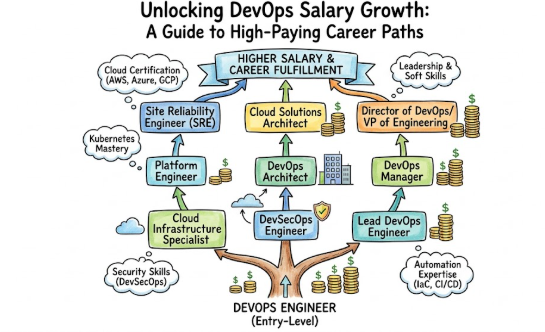 Introduction
In the current landscape of technology, DevOps has emerged as one of the most lucrative and rewarding career paths for IT professionals. As organizations increasingly rely on cloud computing, rapid software delivery, and automated infrastructure, the demand for specialists who can bridge the gap between development and operations has skyrocketed. This shift toward automated, scalable systems has fundamentally changed how businesses operate, creating a global surge in demand for DevOps expertise.High salaries in this field are driven by the critical nature of the work. DevOps professionals are responsible for the stability, security, and efficiency of systems that power modern businesses. As cloud adoption, Kubernetes, and continuous delivery become the industry standard, organizations are competing to hire talent capable of managing these complex environments.This guide provides a transparent look at salary trends, career progression, and the strategic roles that lead to the highest compensation. Whether you are a fresher exploring your first role, a developer looking to shift into infrastructure, or an experienced engineer targeting a senior position, understanding the relationship between skills, organizational maturity, and market value is the key to maximizing your career growth.
Why DevOps Salaries Are High
DevOps salaries are primarily driven by the business value of the role. When your work directly impacts revenue, system uptime, and operational efficiency, your compensation potential increases significantly.
- Cloud Adoption: As companies migrate to multi-cloud and hybrid environments, the complexity of infrastructure management grows, necessitating experts who can handle cloud-native technologies.
- Automation and Reliability: Manual tasks are increasingly viewed as "toil." Professionals who can automate workflows and implement Site Reliability Engineering (SRE) practices are highly valued for reducing long-term operational costs.
- Kubernetes and Containerization: The widespread adoption of container orchestration requires specialized skills that are currently in high demand but relatively scarce.
- DevSecOps Demand: As security becomes integrated into the software development lifecycle (SDLC), specialists who can manage "policy-as-code" and secure pipelines command significant salary premiums.
- The Expertise Gap: There is a persistent lack of professionals who possess both deep technical skills and the ability to treat platform operations as a product, making them highly sought after in the job market.
Who Should Read This Guide
This resource is designed for professionals at various stages of their careers:
- Freshers: Those beginning their journey into cloud and automation.
- Developers & System Administrators: Individuals looking to transition into modern DevOps or SRE roles.
- Specialized Engineers: Cloud engineers, Platform engineers, and DevSecOps professionals aiming to optimize their career trajectory.
- IT Professionals: Anyone looking to understand how to leverage their existing Linux or infrastructure experience for better salary potential.
DevOps Salary Overview
DevOps compensation varies widely based on organizational maturity. The industry is currently bifurcating into distinct pay markets:
- Big Tech / High-Scale Product Organizations: These firms often offer higher total compensation, frequently featuring equity-heavy packages.
- Enterprise / Regulated Industries: Organizations in sectors like finance or healthcare often prioritize stable base salaries and substantial bonuses.
- Services / Outsourcing Companies: Compensation in this sector is typically driven by market rates and project-based requirements.
Salaries generally grow as you transition from a "pipeline implementer" to a "platform owner" or a reliability expert.
DevOps Salary by Experience Level
The following table maps the typical progression of a DevOps professional.
| Experience Level | Typical Roles | Skills Expected | Salary Growth Potential | Career Scope |
| Fresher | Junior DevOps Engineer | Linux, Scripting, Git Basics | Entry-level baseline | Foundation building |
| Mid-Level | DevOps Engineer | CI/CD, Cloud, Docker | Steady growth | System independence |
| Senior | Senior DevOps / SRE | Architecture, Observability | Significant premium | Design and strategy |
| Architect | Platform Engineer | Kubernetes, DevSecOps | High top-end potential | Org-wide direction |
Highest Paying DevOps Roles
Certain specializations command higher premiums due to the scarcity of talent and the high business risk associated with the domain.
| Role | Main Skills | Difficulty Level | Salary Potential | Career Demand |
| Security Platform Engineer | Policy-as-Code, Security SDLC | Very High | Premium | Very High |
| DevSecOps Engineer | Secrets, Pipeline Security | High | High | High |
| Platform Engineer | Internal Developer Platforms | High | High | High |
| SRE Engineer | SLOs, Incident Response | High | High | High |
| Cloud Engineer | Cloud Landing Zones, IAM | Moderate | Moderate/High | Moderate |
DevOps Salary by Skills
Salary growth is directly linked to your ability to solve complex problems. Generic skills like basic CI/CD implementation are becoming baseline requirements. To increase your salary, focus on high-impact areas:
- Platform Engineering: Moving from simply managing pipelines to building internal platforms that enable developer productivity.
- Reliability Engineering: Expertise in SLOs, error budgets, and design reviews (moving from responding to alerts to preventing failures).
- Security Platform: Scaling security controls while enabling developers to move fast.
- Cost Engineering (FinOps): Managing cloud bills and capacity economics, which directly ties your work to company revenue.
Factors That Affect DevOps Salary
Your compensation is not just about the tools you know, but the scope of your responsibility:
- Business Risk: Roles that manage revenue-critical infrastructure or regulatory compliance pay more.
- Operational Maturity: Companies that invest in toil reduction and modern incident management processes retain staff better and offer more competitive pay.
- Decision Authority: Senior roles are paid for their ability to make strategic technical decisions, not just for executing tasks.
- Communication: The ability to explain technical strategy to stakeholders is a major multiplier for senior-level salary growth.
Best Skills for High DevOps Salary
A structured approach to skill acquisition is essential for long-term career growth.
- Beginner Path: Linux, Git, Networking basics, Shell scripting.
- Intermediate Path: Docker, Jenkins, Terraform, CI/CD, Cloud fundamentals.
- Advanced Path: Kubernetes, Cloud architecture, GitOps, Observability, DevSecOps, Platform engineering.
Real-World Career Scenarios
- Developer Moving into DevOps: By leveraging your coding background to automate infrastructure, you can transition into Platform Engineering roles, which bridge the gap between software development and operations.
- System Administrator Moving into Cloud DevOps: Your deep understanding of operating systems and networking is a massive advantage. Focus on shifting from manual server management to Infrastructure-as-Code (IaC) using tools like Terraform.
- SRE/Platform Growth: Seniority in this field is achieved by building systems that allow developers to self-serve, rather than manually responding to individual support requests.
Common Mistakes That Reduce Salary Growth
- Ignoring Fundamentals: Skipping Linux or networking basics in favor of jumping directly to advanced tools.
- Certification Focus: Collecting certificates without demonstrating real-world project outcomes or operational experience.
- Weak Communication: Failing to articulate how your technical work (like platform adoption or reliability) contributes to business outcomes.
- Lack of Automation: Staying in roles that require manual work, which limits your ability to scale your own productivity.
Hands-On Projects to Increase Salary Opportunities
To stand out, build a portfolio that demonstrates your capability:
- Develop a secure, end-to-end CI/CD pipeline.
- Deploy a highly available application on Kubernetes.
- Implement infrastructure-as-code for a multi-region cloud deployment.
- Set up a comprehensive monitoring and observability stack with alerting based on SLIs/SLOs.
FAQs
- Is DevOps a high-paying career?
Yes, because it directly impacts system reliability and operational efficiency, which are critical business requirements. - Which DevOps skill gives the highest salary?
Specialized skills such as Security Platform Engineering, FinOps, and SRE/reliability practices often command the highest premiums. - Is Kubernetes good for salary growth?
Yes, it is a core technology for modern platforms, though it is increasingly becoming a baseline requirement rather than an outlier skill. - Does certification increase salary?
Certifications can help with initial screening, but actual salary growth is driven by project experience, scope of responsibility, and proven operational outcomes.
Final Recommendation
To maximize your salary in the DevOps field, stop focusing on tool knowledge alone and start focusing on operational outcomes. Move from a "pipeline implementer" to a "platform owner." Instead of just responding to alerts, work to implement reliability practices like SLOs and error budgets.Your value lies in your ability to tie your work to reliability, security, and cost-efficiency. Continue learning, build practical projects to demonstrate your expertise, and always look for opportunities to increase your design authority within your organization.
