Mastering Certified MLOps Architect Skills for Production ML Platforms
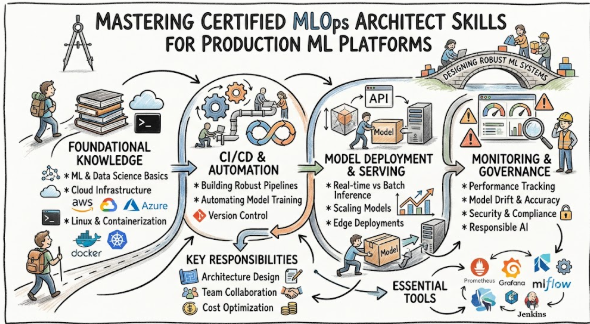
Moving a machine learning model from a laptop to a production environment requires a big shift in how we think about systems. The main challenge is rarely the model algorithm itself. The real challenge lies in building the data pipelines, continuous integration systems, testing strategies, and monitoring frameworks needed to keep that model running reliably at scale.This guide explores how technical professionals can transition into high-level platform engineering for machine learning. The focus will rest on a specific professional benchmark: the Certified MLOps Architect credential.
What is Certified MLOps Architect
The Certified MLOps Architect is an advanced professional certification designed for individuals who want to master the art of operationalizing machine learning models. It bridges the gap between data science and traditional systems engineering.This certification program focuses heavily on designing, building, and managing scalable infrastructure. It teaches engineers how to automate the entire lifecycle of machine learning models, ensuring they remain accurate, secure, and cost-effective in live business environments.
Why it matters today’s ?
In the current enterprise landscape, organizations are moving away from treating machine learning as an experimental science project. Companies are deploying hundreds of models that directly impact revenue, logistics, and user experience.Without a structured operational framework, these models quickly become a burden. Manual deployments lead to errors, system downtime, and untracked costs. This certification matters because it establishes clear, standardized engineering practices to deploy and maintain these complex systems without breaking the budget.
Why Certified MLOps Architect certifications are important
Traditional engineering paths prioritize code versioning and stateless server stability. Machine learning introduces stateful data dependencies and statistical variations that can degrade model performance without triggering standard server errors. A structured operational methodology is required to manage these challenges effectively.Specialized verification proves that an engineer can build systems capable of tracking data lineage, automating model validation gates, and detecting performance drift in live production environments. This standard bridges the operational gap between experimental code and reliable software products.
why choose AIOps School ?
Selecting an educational foundation requires evaluating how well the curriculum mirrors actual engineering environments. The structural program provided by this platform offers distinct advantages for career advancement:
- Platform-Neutral System Design: The material avoids tying your skills to a single cloud vendor. Instead, it focuses on architectural design patterns that apply across multi-cloud and hybrid infrastructures.
- Production-Scale Engineering Labs: Training emphasizes practical, hands-on tasks that simulate enterprise failures, complex resource scheduling, and automated recovery.
- Integrated Modern Practices: The coursework brings data management, security compliance, and financial engineering into the standard infrastructure lifecycle.
Certification Deep-Dive
What is this certification?
This professional milestone evaluates an engineer's capability to build, scale, and secure end-to-end platforms for machine learning lifecycle automation. It moves beyond standard software pipelines to manage the unique challenges of data drift and massive hardware resource coordination.
Who should take this certification?
This curriculum is built for system developers, infrastructure engineering teams, cloud platform architects, and senior data coordinators who want to establish robust deployment standards across enterprise operations.
Certification Overview Table
| Track | Level | Who it’s for | Prerequisites | Skills Covered | Recommended Order |
| Foundation | Beginner | System Administrators, New Data Engineers | Basic Git & Python | Lifecycle Vocabulary, Basic Versioning | First |
| Engineer | Intermediate | DevOps Engineers, Platform Staff | Cloud Basics, Containerization | Automated CI/CD, Container Deployments | Second |
| Professional | Advanced | Senior Infrastructure Specialists | Pipeline Automation | Drift Tracking, Complex Model Serving | Third |
| Architect | Expert | Enterprise Architects, Infrastructure Directors | Advanced Kubernetes & Cloud | Multi-Tenant Platform Design, AI Security | Fourth |
Skills you will gain
- Design complex data processing and feature delivery structures that operate with minimal manual intervention.
- Construct unified version management pipelines that connect changing dataset baselines with corresponding code and final model outputs.
- Build custom monitoring systems that measure input fluctuations and statistical divergence in real-time.
- Formulate strict governance workflows that incorporate compliance auditing directly into the deployment pipeline.
Real-world projects you should be able to do after this certification
- Construct an automated pipeline that pulls updated training datasets, runs quality checks, validates accuracy metrics, and pushes the model to production.
- Implement a high-availability serving layer that splits live user traffic across multiple model versions using canary or blue-green testing frameworks.
- Deploy an enterprise-wide model registry that tracks every asset from its initial training run to its active production cluster node.
Preparation plan
7–14 days plan
Spend the opening two weeks master-testing structural concepts. Dedicate time to understanding technical debt patterns in automated systems and memorizing foundational terminology.
30 days plan
Dedicate this period to working inside sandbox environments. Build baseline packaging scenarios, set up automated code repositories, and configure basic service triggers for system changes.
60 days plan
Focus on large-scale infrastructure designs. Work through multi-tenant security layers, optimize GPU instance groups to reduce unnecessary cloud spending, and test disaster recovery procedures.
Common mistakes to avoid
- Treating Models Like Stateless Code: Failing to account for data dependencies will cause silent pipeline failures that standard test beds cannot catch.
- Neglecting Computational Costs: Spinning up high-performance infrastructure without strict resource tracking leads to rapid, unexpected budget overruns.
- Over-Engineering Basic Workflows: Building highly intricate cluster topologies before an organization establishes baseline data governance creates unnecessary maintenance friction.
Best next certification after this
Same track
Continue advanced technical growth by moving directly toward deep multi-cloud design specializations and automated environment testing methodologies.
Cross-track
Broaden system design capabilities by transitioning into enterprise infrastructure automation programs, specifically focusing on systematic log analysis and large-scale data monitoring.
Leadership / management
Prepare for technical leadership roles by following strategic engineering management courses that specialize in resource planning, vendor assessment, and cross-team execution.
Choose Your Learning Path
DevOps
This path focuses on updating standard delivery systems to support machine learning assets. It introduces automated model testing and deployment gates into traditional application infrastructure.
DevSecOps
This track brings strict safety policies into the automated pipeline. It ensures that data encryption, pipeline access controls, and compliance audits run automatically at every stage of the lifecycle.
Site Reliability Engineering (SRE)
This path focuses on maintaining high availability and low latency across production systems. It builds the alerting, log-aggregation, and self-healing systems needed to keep complex infrastructures stable.
AIOps / MLOps
This track focuses on scaling machine learning platforms across entire enterprises. It balances infrastructure resource scheduling with continuous evaluation systems to keep large fleets of models stable.
DataOps
This path prioritizes the lifecycle of the data itself. It builds the high-capacity pipelines, storage frameworks, and validation checks that feed clean, reliable data into training pipelines.
FinOps
This track focuses on tracking and reducing the costs of high-performance cloud infrastructure. It builds resource monitoring frameworks to ensure massive training and inference clusters run efficiently.
Role → Recommended Certifications Mapping in table
| Role | Recommended Certification Track Focus |
| DevOps Engineer | Advanced Automation and Infrastructure Versioning |
| Site Reliability Engineer (SRE) | Production System Observability and Alerting Systems |
| Platform Engineer | Multi-Tenant Cluster Management and Core Abstractions |
| Cloud Engineer | Compute Scaling and Multi-Cloud Network Architectures |
| Security Engineer | Pipeline Cryptography and Enterprise Compliance Auditing |
| Data Engineer | High-Capacity Storage Arrays and Feature Validation |
| FinOps Practitioner | High-Performance Cluster Cost Optimization Patterns |
| Engineering Manager | Strategic Project Resource Tracking and Governance |
Next Certifications to Take
- One same-track certification: Progressive technical specialization is achieved by exploring deep structural design patterns that maintain stability across distributed systems.
- One cross-track certification: Cross-functional growth is established by studying adjacent platforms that use machine learning to automate infrastructure health checks and log analysis.
- One leadership-focused certification: Strategic leadership positions are targeted by focusing on team management frameworks, technological investment planning, and high-level corporate governance.
Training & Certification Support Institutions
DevOpsSchool
This institution delivers deep foundational coursework that targets continuous integration mechanics and infrastructure configuration management. Their practical approach bridges traditional deployment strategies with modern automated software lifecycles.
Cotocus
This group specializes in custom platform consulting and engineering support workflows. Their training curriculum focuses on building highly scalable runtime architectures and container management layers for varied production teams.
ScmGalaxy
This portal serves as an educational clearinghouse for version management and delivery pipeline techniques. They offer deep-dive technical breakdowns that help engineering departments establish reliable tracking structures.
BestDevOps
This platform offers targeted instructional guides that analyze actual real-world failure points in live production environments. Their syllabus helps system teams build reliable alerting layers and automated rollback workflows.
devsecopsschool.com
This learning facility integrates modern security controls directly into automated software development lifecycles. Their training programs focus on automated scanning, access control management, and pipeline vulnerability assessments.
sreschool.com
This instructional group focuses on maintaining system availability and reliability metrics. Their practical labs cover system monitoring, error budget management, and incident response orchestration across complex networks.
aiopsschool.com
This technical school focuses on data-driven operations and machine learning lifecycle infrastructure. Their certified paths teach engineers how to design, secure, and manage enterprise-scale automated systems.
dataopsschool.com
This educational institution provides courses centered on data engineering orchestration and delivery workflows. Their classes show teams how to create verifiable data pipelines that provide clean data to business systems.
finopsschool.com
This group focuses on cloud financial management and cost optimization techniques for engineering teams. Their material helps technical leads build resource tracking systems that keep infrastructure spending aligned with business outcomes.
FAQs Section
1. What is the overall difficulty level of these infrastructure tracks?
The difficulty level is progressive. The entry-level paths use straightforward concepts, while the architect levels require deep experience with distributed cloud systems, networking, and cluster management tools.
2. What average time commitment is required to finish a program?
The foundational levels can typically be completed in one to two weeks. Advanced architect certifications generally require two full months of dedicated preparation, along with practical lab experimentation.
3. Are there any strict prerequisites before starting the coursework?
Beginner programs require only a baseline knowledge of terminal commands and basic scripting. The expert levels require an understanding of container patterns, cluster management platforms, and distributed system networks.
4. Is it necessary to take these certifications in a specific sequence?
Following the recommended order from foundation to architect provides a smoother learning curve, but experienced professionals with strong existing backgrounds can skip ahead directly to advanced tracks.
5. What concrete career value do these programs offer?
Completing these tracks validates your ability to solve complex system failures and design highly scalable platforms. This helps you stand out for senior engineering, platform design, and infrastructure architecture roles.
6. Which job roles show the highest growth after certification?
Significant professional growth is often seen by platform engineers, DevOps teams, cloud architects, and data infrastructure engineers who need to manage large-scale automated software environments.
7. How are the practical lab evaluations structured?
The assessments use a mix of scenario design challenges and hands-on laboratory exercises. This structure requires you to fix real infrastructure bugs, configure pipelines, and design resilient systems.
8. Are these technical programs recognized globally?
Yes, the certification programs are built around vendor-neutral infrastructure design principles and open standards that are recognized across international tech hubs and enterprise environments.
9. Does the curriculum cover multi-cloud system architectures?
Advanced tracks focus heavily on building cloud-agnostic architectures that deploy and operate reliably across major providers like AWS, GCP, and Azure.
10. How do these tracks address system security?
Security is integrated into every technical layer. The material covers automated code analysis, identity management, pipeline access controls, and data encryption standards.
11. Is there a focus on cost management within the platform tracks?
Yes, financial tracking practices are built into the advanced infrastructure courses to show you how to monitor resource allocation and reduce unnecessary cloud infrastructure spend.
12. What support is available if I run into issues during lab work?
Comprehensive community boards, documentation databases, and technical peer networks provide active troubleshooting support whenever you encounter blocker bugs in the practical labs.
Certified MLOps Architect
1. How does the architect path handle the challenges of scaling large language models?
The curriculum includes specific modules on high-throughput serving systems, distributed memory management, and low-latency inference setups for large-scale production models.
2. Does this course focus on specific open-source workflow tools?
The course teaches the fundamental design principles behind data versioning and model orchestration, using standard open-source tools during the practical lab sessions to demonstrate those concepts.
3. Is pipeline security treated as a core part of the architectural track?
Pipeline security is a major pillar of the program. It covers automated data governance, secure model access, and compliance tracking across the entire deployment cycle.
4. Will I learn how to build an enterprise feature registry from scratch?
The material teaches both the structural design theory and the practical implementation steps required to build and maintain high-performance feature management registries for engineering teams.
5. How are my platform design skills evaluated during the final exam?
The advanced exam uses scenario-based design challenges where you must create a resilient system topology that solves a complex, large-scale enterprise production failure.
6. Does the curriculum address infrastructure cost efficiency for model training?
Cloud cost control practices are built directly into the course labs to show you how to set up auto-scaling rules and leverage spot instances to minimize compute spending.
7. Are hybrid-cloud and multi-region deployment patterns covered?
Yes, the coursework explicitly covers how to design data architectures and serving layers that maintain consistency across multiple geographic cloud regions and on-premise hardware clusters.
8. Is the training material kept up to date with shifting industry standards?
The core curriculum is reviewed regularly by an active network of senior industry specialists to ensure all lab challenges and design patterns match current enterprise infrastructure practices.
Testimonials
1. Amit
The pipeline tracking modules changed how our engineering team manages production deployments. We cut our silent deployment errors significantly after applying the version tracking patterns taught in the labs.
2. Beatrice
The practical insights into cluster scaling helped me completely redesign our high-performance infrastructure setup. The course provides clear, direct guidance on managing resource allocation without wasting cloud spend.
3. Chetan
I gained massive clarity on how to bridge the gap between our analytics teams and our platform engineering staff. The material provides a clear framework for building shared, automated infrastructure gates.
4. Divya
The focus on automated compliance scanning helped us integrate security audits directly into our daily shipping cycles. Our production environments are now much more secure, and our deployment confidence has increased.
5. Ethan
This course gives you a comprehensive architectural roadmap that goes far beyond basic tutorial scripts. It helped me step into a senior platform role with a clear strategy for managing our entire delivery infrastructure.
Conclusion
Building infrastructure for machine learning requires a strong focus on automation, reliability, and security. The Certified MLOps Architect program provides a clear, practical framework for mastering these challenges at enterprise scale.Investing in structured validation helps systems engineers transition into vital platform roles that keep production environments running smoothly. Review the learning paths, choose a focus area that matches your current background, and begin building more resilient automated platforms.
