Practical MLOps Foundation Certification Roadmap for AI and DevOps Professionals
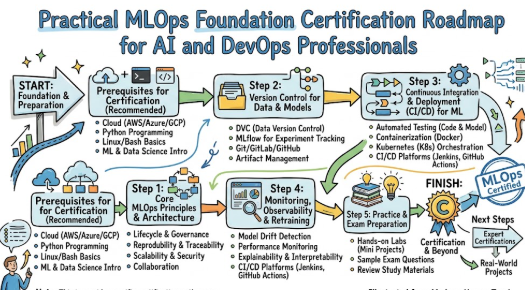
Introduction
Building and deploying software has changed dramatically over the last few years. In the past, writing code and shipping it to a server was enough. Then came cloud computing, which required faster deployment cycles. Now, the biggest challenge in the technology space is managing artificial intelligence and machine learning models.Many smart software engineers and systems administrators know how to build a machine learning model using data science tools. However, taking that model and making it run reliably for millions of users in production is an entirely different problem. This gap between data science and real-world software operations is where machine learning operations, or MLOps, becomes critical.To solve this industry-wide issue, specific training programs have been developed to teach engineers how to automate, deploy, and monitor these intelligent systems. This comprehensive guide is written to analyze the MLOPS foundational training program designed to bridge this operational gap. It provides a detailed breakdown of the curriculum, learning paths, and real-world outcomes that can be expected by professionals looking to upgrade their skills.
Understanding the Essentials of the Foundational Program
The machine learning lifecycle involves data preparation, model training, model deployment, and continuous monitoring. In a typical software system, code is static until a developer updates it. In an artificial intelligence system, the data changes constantly, which means the model behavior changes as well. This introduces a unique challenge called model drift, where a system becomes less accurate over time because the real world has changed.This specific operational certification is built to teach software professionals how to apply reliable systems engineering principles to machine learning workflows. It does not focus heavily on complex mathematical formulas or deep data science theory. Instead, it focuses on the practical mechanics of pipelines, data versioning, containerization, and continuous delivery for intelligent applications.The program serves as an entry point for anyone who wants to understand how automated workflows can be built around data pipelines. It provides clear, step-by-step guidance on how to treat data and models as first-class citizens in a traditional software deployment pipeline.
Why Modern Technology Teams Require This Knowledge
Traditional software configuration management tools are not entirely sufficient for systems that rely on data patterns. When an error occurs in a standard web application, it is usually caused by a bug in the code. When an error occurs in an automated prediction system, it could be caused by bad data, an outdated model, or an unexpected change in user behavior.Organizations across the globe are realizing that expensive artificial intelligence projects often fail because they cannot be moved out of the laboratory phase. Millions of dollars are spent on data science teams, yet the models remain stuck on local desktop computers. This creates a massive demand for engineering professionals who understand how to package these models into stable, production-ready microservices.By mastering these foundational skills, engineering teams can significantly reduce the time it takes to deploy a new feature from months to a few hours. It also ensures that systems are built with automated guardrails, so that if a model starts making incorrect predictions, the system can automatically roll back to a previous, stable version without human intervention.
The Long-Term Value of Validation
Obtaining a structured credential in this field serves as a clear signal to the technology market. It demonstrates that an engineer does not just write basic scripts, but actually understands the entire architectural lifecycle of modern, data-driven systems. It validates that a professional knows how to collaborate across separate teams, specifically bridging the gap between data scientists, infrastructure teams, and security groups.For the individual professional, this knowledge opens up advanced career opportunities that carry significant premium value in the employment market. Companies are actively searching for individuals who can save them from infrastructure waste and broken deployments. Having a structured validation path provides a standardized framework, ensuring that everyone on a modern engineering team speaks the exact same technical language.
Why Choose AIOps School?
When selecting an AIOpSSchool institution for advanced operational training, the depth of practical focus must be evaluated closely. This platform is chosen by many industry professionals because the curriculum is designed entirely around real-world scenarios rather than dry, theoretical textbook lectures. The learning modules are structured to match the fast-changing demands of modern production environments, ensuring that what is studied can be applied immediately on the job.The education provided here is delivered by individuals who have spent years managing large-scale cloud systems and automated pipelines. Complex architectural concepts are broken down into simple, manageable lessons that can be grasped easily by standard developers and systems engineers. Additionally, the learning environment offers comprehensive support structures that guide a learner seamlessly from basic initial concepts all the way to advanced automated deployments.
Deep-Dive into the Core Syllabus
What is this certification?
This entry-level program is a structured learning path that teaches the fundamental concepts of managing, deploying, and monitoring machine learning models in live cloud environments. It provides a clear blueprint for automating data workflows and aligning development tasks with infrastructure operations.
Who should take this certification?
This course is specifically structured for working software developers, systems administrators, cloud engineers, security professionals, and technology managers who need to oversee the deployment of data-driven software systems.
Structured Learning Tracks Table
| Track | Level | Who it’s for | Prerequisites | Skills Covered | Recommended Order |
| Core Systems Automation | Beginner | Systems Administrators | Basic Linux command line | Scripting, environment setup, infrastructure basics | First |
| Data Workflow Architecture | Intermediate | Data Developers | Basic database knowledge | Data pipelines, versioning tools, storage management | Second |
| Model Packaging & Shipping | Intermediate | Software Engineers | Container basics | Containerization, microservices, deployment strategies | Third |
| Continuous Integration Flow | Advanced | DevOps Professionals | Basic pipeline knowledge | Automated testing, delivery chains, rollback systems | Fourth |
| Live Systems Observability | Advanced | Reliability Engineers | Monitoring concepts | Log analysis, metric collection, alert configuration | Fifth |
Skills You Will Gain
- Designing automated pipelines for continuous model deployment.
- Implementing strict version control for large datasets and model parameters.
- Packaging machine learning applications into lightweight, secure containers.
- Configuring monitoring systems to detect data drift and performance drops.
- Establishing automated rollback procedures for failed live updates.
- Collaborating effectively between data science groups and IT infrastructure teams.
Real-World Projects Practiced
- Building an automated pipeline that builds, tests, and deploys a model whenever data updates.
- Setting up a complete data tracking repository to log versions of a large customer dataset.
- Creating a containerized web service that serves model predictions with low latency.
- Configuring an open-source dashboard to track system metrics and trigger alerts for anomalies.
Recommended Preparation Schedules
7–14 Days Preparation Plan
- Days 1-4: Focus entirely on core architectural theories, terminology, and lifecycle stages.
- Days 5-8: Study container packaging methods and basic data tracking tools through simple practical exercises.
- Days 9-11: Review automated pipeline configurations and review sample exam questions.
- Days 12-14: Take full-length practice tests, analyze weak areas, and finalize documentation review.
30 Days Preparation Plan
- Week 1: Dedicate time to understanding the foundational differences between code updates and data updates.
- Week 2: Spend two hours daily building simple local data pipelines and version control repositories.
- Week 3: Deeply explore container isolation, microservice deployments, and automated testing setups.
- Week 4: Focus on cloud monitoring configurations, error logs, practice quizzes, and final exam scheduling.
60 Days Preparation Plan
- Month 1 (Weeks 1-4): Build a solid foundation by studying cloud infrastructure, basic python scripting, and foundational data science concepts slowly.
- Month 2 (Weeks 5-8): Execute multiple end-to-end automation projects, configure live monitoring dashboards, study failure recovery strategies, and complete comprehensive practice evaluations.
Common Mistakes to Avoid
- Spending too much time learning complex data science algorithms instead of operational tooling.
- Neglecting the study of data version control systems and focusing only on standard code repositories.
- Forgetting to study monitoring strategies, which form a major portion of production environments.
- Skipping hands-on lab exercises and relying entirely on memorizing text-based study guides.
Continuing Education Options
One same-track certification
An advanced, specialized credential within the operational automation space should be selected next to deepen expertise in automated workflows and continuous delivery architectures.
One cross-track certification
A security-focused or reliability-centric validation path should be chosen to learn how automated pipelines can be hardened against vulnerabilities and configured for high availability.
One leadership-focused certification
An enterprise architecture or technology management credential must be pursued to transition from basic engineering tasks to managing large-scale engineering teams and driving business strategy.
Six Custom Pathways for Technical Professionals
The Operations Engineer Route
This path is tailored for professionals who are already skilled in infrastructure configuration and continuous integration. The focus here is placed on adding data pipelines and model parameters into existing software deployment flows.
The Security Integration Route
This pathway is designed for engineers focused on protecting corporate assets. It teaches how data sets can be scanned for privacy compliance and how model endpoints can be secured against malicious injections.
The Live Systems Reliability Route
This track is structured for professionals who keep systems online and highly available. It covers advanced tracking of latency, memory utilization of large models, and automatic scaling of infrastructure.
The Intelligent Automation Route
This path is built for specialists focusing entirely on advanced operations driven by data analytics. It blends traditional infrastructure management with proactive, automated system healing driven by machine learning alerts.
The Data Infrastructure Route
This sequence is created for professionals who clean, transform, and move massive volumes of information. It addresses the storage challenges and version tracking requirements necessary before a model can even be trained.
The Financial Optimization Route
This specialized track is meant for professionals who manage cloud spending. It explores how expensive computing hardware can be managed efficiently, ensuring that model training does not cause budget overruns.
Role to Certification Recommendation Matrix
| Professional Role | Highly Recommended Validation | Focus Area |
| DevOps Engineer | Pipeline Automation Specialist | Continuous Delivery Chains |
| Site Reliability Engineer | Live Observability Specialist | High Availability & Alerting |
| Platform Engineer | Internal Infrastructure Specialist | Developer Self-Service Systems |
| Cloud Engineer | Multi-Cloud Resource Specialist | Scalable Computing Pools |
| Security Engineer | Secure Pipelines Specialist | Vulnerability & Access Scanning |
| Data Engineer | Storage & Pipeline Specialist | Mass Data Transformation |
| FinOps Practitioner | Cost Optimization Specialist | Resource Allocation Tracking |
| Engineering Manager | Enterprise Delivery Specialist | Strategic Scaling & Governance |
Recommended Learning Support Entities
DevOpsSchool
This training organization provides extensive, live instructor-led sessions covering fundamental infrastructure automation. Deep practical knowledge regarding continuous integration pipelines can be acquired here.
Cotocus
Comprehensive corporate training solutions are delivered by this entity, focusing heavily on container orchestration systems. Real-world migration scenarios are emphasized across their standard curriculum.
ScmGalaxy
A massive community repository of tutorials, blogs, and technical configuration guides is maintained by this platform. It serves as an excellent reference point for troubleshooting continuous deployment issues.
BestDevOps
Structured, self-paced learning programs designed for modern IT professionals are hosted on this platform. Step-by-step video lessons are provided to help students master complex tool configurations easily.
devsecopsschool.com
This online educational portal is dedicated entirely to embedding security practices directly into automated pipelines. Compliance checking and security testing methods are deeply explored here.
sreschool.com
Educational resources focused on building fault-tolerant systems and managing production failures are provided by this platform. Advanced monitoring and incident response strategies are thoroughly taught.
aiopsschool.com
This highly specialized platform focuses entirely on data-driven operations and intelligent automation systems. It serves as the primary provider for certifications that bridge the gap between artificial intelligence and infrastructure engineering.
dataopsschool.com
Comprehensive learning tracks centered on data quality management and automated data pipeline construction are offered here. It helps engineers build solid pipelines for large-scale data systems.
finopsschool.com
Financial management in cloud computing environments is the sole focus of this educational site. Techniques for analyzing cloud bills and optimizing automated resource usage are systematically covered.
General Certification FAQs
1. What is the overall difficulty level of these operational tests?
The foundational evaluations are generally considered moderate, focusing heavily on core concepts, clear definitions, and basic architectural components rather than complex programmatic scripting.
2. How much time must be dedicated weekly to clear the initial exam?
A dedication of roughly six to ten hours per week over a period of one month is usually sufficient for a working professional to feel completely prepared.
3. Are there any strict academic prerequisites required to register?
No formal university degrees are mandated, but a basic familiarity with standard cloud concepts and command-line interfaces is highly recommended.
4. What is the recommended order for completing these tracks?
It is always advised to complete the basic infrastructure and data pipeline modules first before moving into advanced live systems monitoring and security auditing courses.
5. How does this validation improve long-term career growth?
It establishes a clear proof of modern technical capability, moving an individual out of simple legacy maintenance roles into high-value architecture positions.
6. Which job roles show the highest adoption of these methodologies?
Platform engineers, cloud infrastructure specialists, and senior systems analysts show the highest rate of professional value addition from these programs.
7. Is hands-on programming experience required to pass?
Deep software coding skills are not tested heavily at the foundational level, but the ability to read basic automation scripts is highly beneficial.
8. How long does the official credential remain valid?
Most industry-standard credentials remain fully valid for a period of two to three years, after which a brief refresher assessment is typically required.
9. Can these exams be taken remotely from home?
Yes, modern testing options allow these assessments to be completed online via secure, proctored browser applications.
10. Are study materials provided directly by the platform?
Comprehensive documentation, video lectures, and sample practice questions are accessible directly through the official student portal upon registration.
11. How do these operational principles differ from standard software development?
Standard development focuses on code logic, while these operational methodologies manage the complex interplay between code, data pipelines, and changing infrastructure.
12. What kind of salary growth can be expected after validation?
While individual outcomes vary based on location and experience, certified professionals frequently command premium packages due to the rare combination of skills verified by the badge.
Specialized MLOps Foundation Certification FAQs
1. What is the primary focus of the MLOps Foundation Certification?
The primary focus is placed on teaching the end-to-end lifecycle of machine learning models, specifically covering automation, deployment consistency, and cloud infrastructure management.
2. Does this specific test involve complex mathematical equations?
No, complex calculus or statistical mathematics are not included in this exam. The curriculum is focused strictly on system configurations and pipeline mechanics.
3. Which specific tools are covered within this foundational syllabus?
Basic tracking systems, container engines, automated deployment pipelines, and live metric dashboards are explored throughout the coursework.
4. How can model drift be identified using the skills taught here?
Methods for setting up automated data baselines and configuring alerts when live production inputs begin to deviate from historical training data are thoroughly explained.
5. Why is containerization a critical component of this program?
Containers ensure that a machine learning model runs in the exact same environment during production as it did during the initial testing phase, eliminating environmental bugs.
6. Can a traditional DevOps engineer transition easily using this course?
Yes, this course is perfectly structured for that exact transition, as it builds directly upon existing continuous integration knowledge while introducing unique data challenges.
7. What is the structure of the final assessment?
The evaluation consists of multiple-choice questions designed to test situational problem-solving, architectural familiarity, and core operational vocabulary.
8. How does this certification address data privacy concerns?
Basic governance methods, access control list configurations, and secure data handling procedures within automated pipelines are highlighted in the final sections.
Professional Experiences and Feedback
Testimonial from Rajesh
The entire deployment workflow of our team was transformed after this program was completed. The confidence to manage large data pipelines in production was truly gained.
Testimonial from Vikram
Clarity on how to handle version control for changing model structures was finally achieved. The practical examples provided were immediately applicable to our live cloud infrastructure.
Testimonial from Amit
A complete shift in career direction was experienced after earning this badge. The barrier between our data scientists and systems operations was successfully broken down.
Testimonial from Sunita
Security compliance monitoring within our automated release cycles was made simple. This course provided a structured approach that eliminated a lot of guesswork.
Testimonial from Rohan
Managing infrastructure costs for large-scale prediction services became much easier. The strategies learned have helped our department save significant cloud resources.
Conclusion
The evolution of modern software architecture makes it clear that data-driven applications are no longer an optional luxury. They are becoming the core driver of enterprise business value. However, the systems that support these applications must be built with the same discipline, security, and automation found in traditional software environments.Earning the MLOps Foundation Certification is a powerful, strategic move for any technology professional who wants to remain highly competitive in the modern employment market. By mastering the core concepts of automated delivery, containerized model packaging, and live environment monitoring, engineers can protect their careers against obsolescence. Planning a structured learning path today ensures a solid professional foundation for the future.
