Certified MLOps Professional Skills for Continuous Machine Learning Delivery
1. Introduction
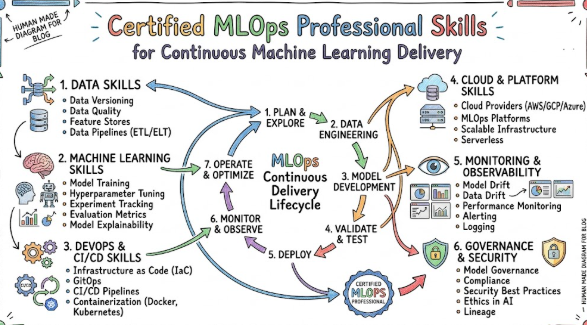
The engineering practices used for traditional software deployment are often found to be insufficient for machine learning. When data and code change simultaneously, systems become complex to maintain, monitor, and scale. This guide is written to analyze how professional validation helps engineers master these specific production challenges.A clear roadmap is provided in the following sections for software engineers, platform specialists, and engineering managers who want to validate their skills in managing machine learning lifecycles. The core competencies required to run reliable machine learning operations at scale are detailed throughout this text.
2. What is Certified MLOps Professional
This Certified MLOPS professional credential is an advanced certification designed for engineers who operate complex machine learning systems in live production environments. It goes beyond basic model deployment to validate deep expertise in running rigorous online experiments, implementing enterprise governance, and optimizing infrastructure performance.
Why it matters today?
Many machine learning models fail to reach production because teams lack the operational framework to deploy and maintain them safely. In today's market, businesses require automated systems that can handle real-time inference, detect data drift, and perform continuous model retraining without manual intervention. Reliability and predictability are brought to AI systems by applying stable engineering principles.
Why Certified MLOps Professional certifications are important
Standard IT deployment methods do not account for the unpredictable nature of machine learning data. This certification is important because it proves an engineer can design pipelines that treat data, code, and models as unified, version-controlled assets. It provides a benchmark that separates theoretical knowledge from practical, production-level platform engineering capability.
Why choose AIOps School?
- Comprehensive curriculum covering advanced production topics like multi-model serving, A/B testing, and hardware acceleration.
- Practical hands-on labs that simulate real-world system failures, model degradation, and deployment bottlenecks.
- Highly structured learning pathways designed by industry practitioners to match modern enterprise infrastructure needs.
- Global recognition that helps technical professionals validate their architecture design skills to enterprise employers.
3. Certification Deep-Dive
What is this certification?
The Certified MLOps Professional credential validates an engineer's ability to operate complex machine learning systems at scale. It focuses heavily on model governance, performance optimization, automated retraining pipelines, and advanced production monitoring.
Who should take this certification?
This program is built for DevOps engineers, cloud infrastructure specialists, data engineers, platform architects, and engineering managers who are responsible for the stability and cost-efficiency of machine learning production platforms.
Certification Overview Table
| Track | Level | Who it’s for | Prerequisites | Skills Covered | Recommended Order |
| AIOps Track | Foundation | System Administrators, IT Support Specialists | Basic IT infrastructure knowledge | AI-driven alerting, anomaly detection, noise reduction | 1 |
| MLOps Track | Engineer | DevOps Engineers, Cloud Engineers | Docker, Kubernetes, basic CI/CD knowledge | ML pipelines, feature stores, model serving, CI/CD for ML | 2 |
| MLOps Track | Manager | Product Managers, Team Leads | Basic understanding of ML lifecycles | Model risk management, ROI calculation, team strategy | 3 |
| MLOps Track | Professional | SREs, Advanced Platform Engineers | Kubernetes, intermediate ML infrastructure | Multi-model serving, A/B testing, model governance | 4 |
| MLOps Track | Architect | Principal Engineers, Infrastructure Architects | Complete MLOps lifecycle experience | Enterprise platform design, multi-cloud ML, scaling | 5 |
Skills you will gain
- Design and execution of statistically sound A/B testing and multi-armed bandit strategies for live models.
- Optimization of model inference for ultra-low latency using quantization, pruning, and hardware acceleration.
- Management of multi-model serving architectures with dynamic model routing and ensemble prediction workflows.
- Implementation of strict model governance frameworks including automated audit trails and lineage tracking.
- Set up of advanced monitoring systems for real-time statistical drift and data anomaly detection.
- Construction of automated, trigger-based continuous training pipelines with validation gates.
Real-world projects you should be able to do after this certification
- Build a multi-model routing gateway that dynamically switches traffic between model variants based on latency or input features.
- Establish a zero-downtime canary deployment pipeline for an enterprise machine learning model using automated rollback metrics.
- Configure a complete model monitoring system that flags covariate shift and automatically triggers a retraining workflow in Apache Airflow.
- Implement an enterprise compliance pipeline that logs full data-to-model lineage to satisfy regulatory audit requirements.
Preparation plan
7–14 days plan
Focus is placed on reviewing the core modules of production machine learning systems. Time is spent understanding the theoretical foundations of A/B testing, model governance frameworks, and basic inference optimization. The official documentation is thoroughly reviewed, and focus is given to understanding how data drift differs from concept drift.
30 days plan
Hands-on labs are incorporated to build functional pipelines. Exercises involving model serving frameworks, containerized environments, and feature store connections are performed. Practice exams are utilized to test scenario-based decision-making under time constraints, and optimization techniques like quantization are practiced.
60 days plan
Deep architectural patterns for multi-model serving and enterprise-wide automation are studied. Complex failure scenarios, edge cases in monitoring, and resource sharing across specialized hardware are analyzed. Comprehensive capstone exercises are completed to ensure that pipelines can handle large scale loads reliably.
Common mistakes to avoid
- Treating machine learning models like static software code during pipeline configuration.
- Neglecting data validation steps before trigger-based automated retraining cycles begin.
- Overlooking the heavy compute cost and latency overhead of unoptimized model serving frameworks.
- Failing to establish proper baseline metrics, making statistical drift detection inaccurate.
Best next certification after this
- Same track: Certified MLOps Architect (Focuses on enterprise-wide infrastructure platforms and multi-cloud systems engineering).
- Cross-track: Certified AIOps Professional (Focuses on utilizing artificial intelligence to automate broad IT operations and monitoring infrastructure).
- Leadership / management: Certified MLOps Manager (Focuses on team building, return on investment calculation, and ethical deployment strategies).
4. Choose Your Learning Path
DevOps Path
This path is tailored for engineers who already possess strong continuous integration and infrastructure automation skills. Focus is placed on extending existing pipelines to accommodate data versioning, model registries, and artifact management, transforming standard code delivery into machine learning delivery pipelines.
DevSecOps Path
This pathway is designed for security specialists who must protect the machine learning lifecycle. It focuses on implementing automated dependency scanning for model libraries, securing feature store access, preventing adversarial prompt injection, and auditing model lineage for regulatory compliance.
Site Reliability Engineering (SRE) Path
This path is structured for professionals focused on system availability, performance, and latency. Attention is given to configuring auto-scaling model endpoints, managing specialized hardware pools like GPUs, setting up alerting for inference failures, and ensuring high availability across multi-region clusters.
AIOps / MLOps Path
This integrated path is built for operations specialists who want to blend model management with intelligent IT operations. It links the performance of deployed machine learning models directly with AI-driven root cause analysis and automated incident response tools across the infrastructure stack.
DataOps Path
This track is meant for data engineers who manage the upstream systems feeding machine learning models. It emphasizes data quality automation, reproducible pipeline orchestration, feature storage optimization, and reducing the time it takes to move raw data into training-ready formats.
FinOps Path
This path is designed for financial and cloud resource analysts working with machine learning infrastructure. It centers on monitoring the high costs of model training, optimizing GPU utilization rates, managing inference cloud spend, and implementing cost-allocation tags across complex engineering clusters.
5. Role → Recommended Certifications Mapping
| Role | Recommended Certifications | Primary Focus Area |
| DevOps Engineer | Certified MLOps Engineer | Automation of machine learning pipelines, artifact registries, and container deployments. |
| Site Reliability Engineer (SRE) | Certified MLOps Professional | High availability, model performance optimization, and advanced drift monitoring. |
| Platform Engineer | Certified MLOps Architect | Enterprise machine learning platform design and shared infrastructure scaling. |
| Cloud Engineer | Certified MLOps Engineer | Cloud-native model serving orchestration, storage scaling, and compute cluster management. |
| Security Engineer | Certified DevSecOps Professional | Supply chain security for machine learning models and automated regulatory compliance. |
| Data Engineer | Certified DataOps Professional | Automated data pipeline health, feature store synchronization, and source data lineage. |
| FinOps Practitioner | Certified FinOps Professional | Cloud cost governance, specialized hardware resource optimization, and training budget tracking. |
| Engineering Manager | Certified MLOps Manager | Team structural design, machine learning project risk reduction, and ROI measurement. |
Next Certifications to Take
- One same-track certification: The Certified MLOps Architect credential can be pursued next to expand expertise into designing enterprise-grade, multi-tenant machine learning platforms that serve multiple business units.
- One cross-track certification: The Certified AIOps Professional credential can be taken to learn how machine learning algorithms are applied directly to log analysis, noise reduction, and automated incident management for core enterprise infrastructure.
- One leadership-focused certification: The Certified MLOps Manager program can be chosen to gain the strategic framework required for vendor selection, regulatory risk management, and the coordination of cross-functional engineering teams.
6. Training & Certification Support Institutions
DevOpsSchool
Comprehensive training programs and continuous learning support are provided by this platform for individuals transitioning into modern cloud operations. Hand-on laboratories and guided learning paths are emphasized to ensure technical concepts are translated directly into usable workforce skills.
Cotocus
Enterprise-grade coaching and specialized software delivery consulting are delivered by this organization. Deep architectural training is combined with practical case studies to help engineering teams adopt scalable methodologies across automation, cloud, and machine learning infrastructure.
ScmGalaxy
A wide library of educational resources, technical community forums, and tools optimization workshops are maintained by this group. Focus is placed on configuration management, platform security, and the integration of emerging deployment frameworks for technical professionals.
BestDevOps
Structured skill-building tracks designed specifically to meet current industry demands are offered here. Step-by-step guidance is paired with practical environments to help technical writers, software engineers, and system admins upgrade their system deployment capabilities.
devsecopsschool.com
Educational materials completely dedicated to the intersection of security automation and modern software delivery are provided by this platform. Comprehensive coursework details how vulnerability scanning and security gates are integrated into high-speed deployment pipelines.
sreschool.com
Specialized training focused on reliability engineering, fault tolerance design, and distributed systems monitoring is delivered by this institution. Engineers are taught how to establish proper service level objectives and handle large-scale system incidents.
aiopsschool.com
An industry-aligned training framework dedicated exclusively to artificial intelligence in operations and machine learning lifecycle management is run by this site. Certification tracks are provided that validate technical mastery from foundational concepts up to enterprise architecture design.
dataopsschool.com
This learning facility focuses entirely on pipeline repeatability, data quality monitoring, and data architecture governance. Training programs are built to help professionals treat data lifecycles with the same automation rigor found in software engineering.
finopsschool.com
Financial accountability frameworks and cloud cost optimization strategies for modern infrastructure are taught by this training provider. Curriculums emphasize how engineering decisions directly impact cloud spending and business unit efficiency.
7. FAQs Section
What is the difficulty level of the Certified MLOps Professional exam?
The exam is considered advanced because it tests complex production scenarios, requiring a strong understanding of both systems infrastructure and statistical model behaviors in live environments.
How much time is required to prepare for this certification program?
A preparation window of 30 to 60 days is generally required, depending on an individual's existing experience with container orchestration and machine learning engineering concepts.
Are there any hard prerequisites before attempting the professional level exam?
No strict certifications are required beforehand, but a foundational knowledge of Docker, Kubernetes, and machine learning lifecycles is highly recommended for success.
What is the recommended certification sequence within the MLOps track?
The path should begin with the MLOps Foundation, progress to the Certified MLOps Engineer level, advance to the Certified MLOps Professional, and conclude with the Certified MLOps Architect credential.
What career value is added by obtaining this professional validation?
It provides clear market differentiation by verifying that an engineer can handle the operational stability of machine learning systems, a skill set that is highly valued by enterprise employers.
Which job roles are aligned with this learning program, and what is the growth potential?
Aligned roles include MLOps Engineer, Platform Engineer, and SRE, with significant career growth expected as more organizations shift machine learning models from development into live production.
Does the certification curriculum include practical infrastructure tools?
Yes, the program covers the architectural integration of tools like feature stores, model registries, container platforms, and continuous delivery orchestration systems.
How long does the official certification credential remain valid?
The certification remains valid for two years, after which a renewal process is available to ensure alignment with updated operational standards and technologies.
Is the exam composed of theoretical questions or practical problems?
The assessment utilizes a combination of multiple-choice questions and complex, scenario-based problems that simulate real-world production platform failures.
How does this certification address cloud infrastructure spending concerns?
The curriculum incorporates specific performance optimization modules that teach engineers how to reduce infrastructure costs through efficient resource utilization and model compression.
Can a traditional software engineer transition into this field using this program?
Yes, the structured path allows software engineers to build upon their existing coding knowledge by learning the specific delivery requirements of machine learning systems.
How is model security handled within the scope of this certification?
The program includes governance modules that cover model risk management, regulatory tracking, and compliance validation gates within deployment pipelines.
Certified MLOps Professional FAQs
1. What unique focus area sets the Certified MLOps Professional apart from other engineering tracks?
The professional level focuses heavily on the post-deployment phase, specifically addressing online experimentation, advanced monitoring, and real-time model serving optimization at scale.
2. How deeply does this certification cover statistical drift detection?
It covers the design and automation of advanced drift detection algorithms that monitor feature input changes and trigger alerts before model accuracy degrades significantly in production.
3. What types of multi-model serving patterns are evaluated in the exam?
The exam evaluates knowledge regarding model routing logic, ensemble serving architectures, cascading inference configurations, and dynamic loading of model assets.
4. How does the program address regulatory compliance for artificial intelligence systems?
It details the implementation of automated model governance pipelines that record precise lineage tracking, data versioning, and audit trails required by enterprise compliance standards.
5. What inference optimization techniques are mastered during preparation?
Practitioners learn to implement model quantization, structural pruning, knowledge distillation, and smart request batching to achieve low-latency predictions on specialized hardware.
6. Are online experimentation frameworks like multi-armed bandits included in the syllabus?
Yes, the course modules specifically cover the architectural layout, traffic splitting strategies, and statistical validity checks required for live multi-armed bandit testing.
7. What infrastructure patterns are taught for continuous training pipelines?
The curriculum teaches trigger-based automated retraining mechanics, data freshness policy validation, and automated model health gates required for safe production rollouts.
8. How does this credential benefit an engineering organization's bottom line?
It ensures that infrastructure costs are minimized through correct model tuning and that business metrics are protected from silent model failures or inaccurate predictions.
8. Testimonials
"The deep dive into online experimentation provided the exact skills needed to build our internal testing platform. Our model deployment cycle is now fully automated and verifiable."— Rajesh
"Understanding model drift detection at an architectural level allowed me to establish proper alerting systems for our finance pipelines. System predictability has increased significantly."— Ananya
"The performance optimization modules helped our team reduce inference latency by half across our container clusters. Cloud infrastructure spend is now managed much more efficiently."— Vikram
"This program provided clear structural guidance on how to secure our machine learning pipelines and track asset lineage. It has changed our entire approach to model governance."— Sunita
"As an engineering leader, the strategic frameworks covered in the curriculum helped align our development cycles with clear operational guardrails. Project risk has been greatly reduced."— David
9. Conclusion
The transition of machine learning from an experimental novelty into a core business capability requires disciplined operations. The Certified MLOps Professional program provides the exact technical framework needed to bridge the gap between model training and live production reliability. By validating skills in performance engineering, advanced monitoring, and governance, technical professionals position themselves for long-term career growth in a rapidly expanding sector. Planning a structured learning journey around these core competencies is a highly strategic step toward mastering enterprise infrastructure challenges.
